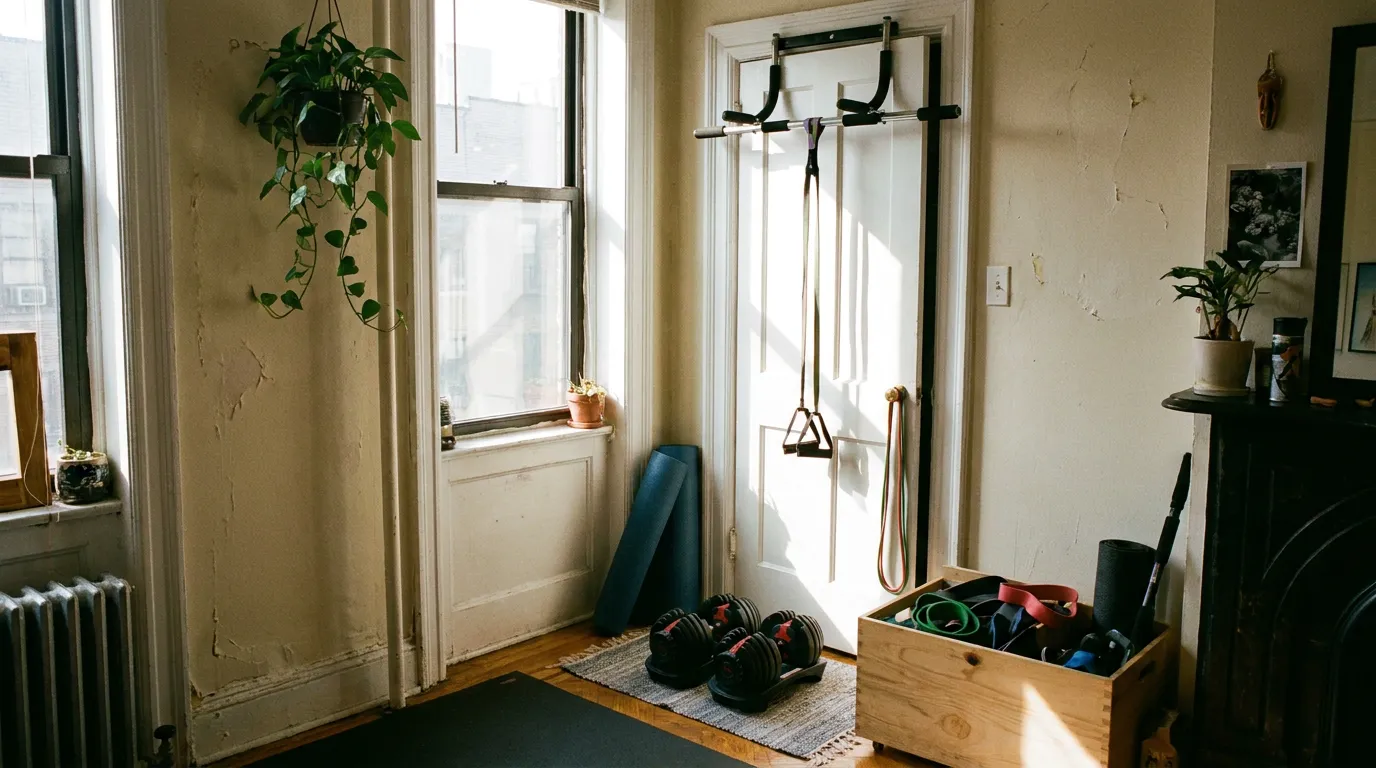
You reach home after a long, stressful day at the office. You feel completely exhausted, your shoulders are tight from staring at a monitor, and the thought of traveling to a crowded commercial gym feels impossible.
But here is what exercise physiology confirms: physical fatigue is not always systemic.
Most of the exhaustion you feel after an 8-hour workday is mental and emotional, driven by prolonged cognitive load and elevated cortisol levels. Forcing a heavy, joint-straining lifting session can worsen this fatigue, but engaging in a restorative, 30-minute full-body circuit is highly effective at releasing muscular tension, boosting circulation, and preparing your body for restful sleep.
This guide provides a practical, space-saving blueprint for highly effective, under-30-minute weeknight sessions.
The Biology of Evening Home Training
When you sit at a desk for hours, your glutes become neurologically dormant (glute amnesia) and your chest and hip flexors tighten.
To reverse this desk-bound stiffness without raising your heart rate into an explosive “fight-or-flight” state, your evening routine should prioritize:
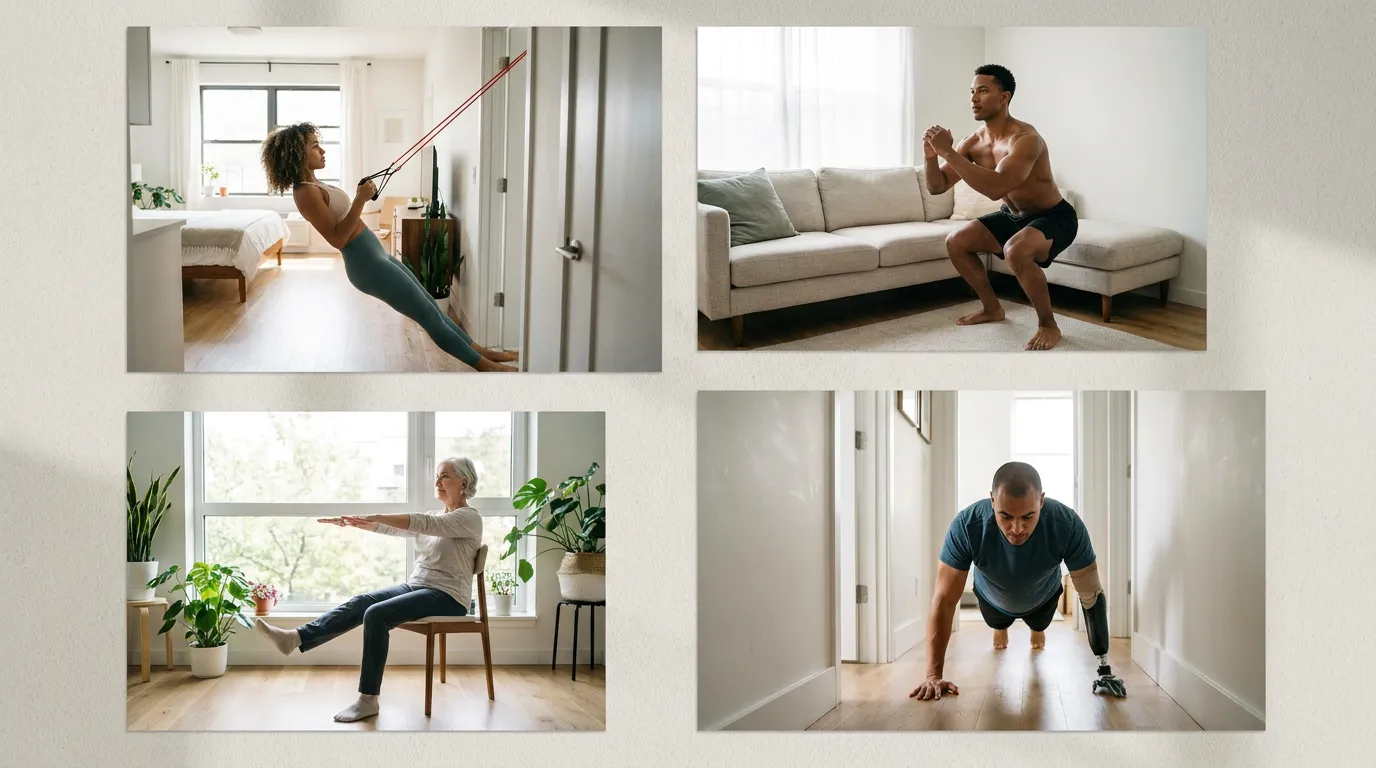
- Controlled, Rhythmic Compound Movements: Squats and lunges open tight hips and activate dormant glutes using reciprocal inhibition [3].
- Upper-Body Decompression: Doorframe rows and incline push-ups open your chest and align your shoulder blades.
- Deep Core Bracing: Planks and dead bugs stabilize your spine and pelvis.
By avoiding explosive jumps, you protect your lower-body joints and keep your nervous system in a parasympathetic (rest-and-recovery) state, which supports natural circadian rhythms and healthy sleep cycles [4].
The Manual 30-Minute Evening Routine
The program detailed below is an independent, highly effective manual layout you can follow if you choose to train on your own.
Manual alternative: If you are training independently, execute this 30-minute sequence using standard home timers.
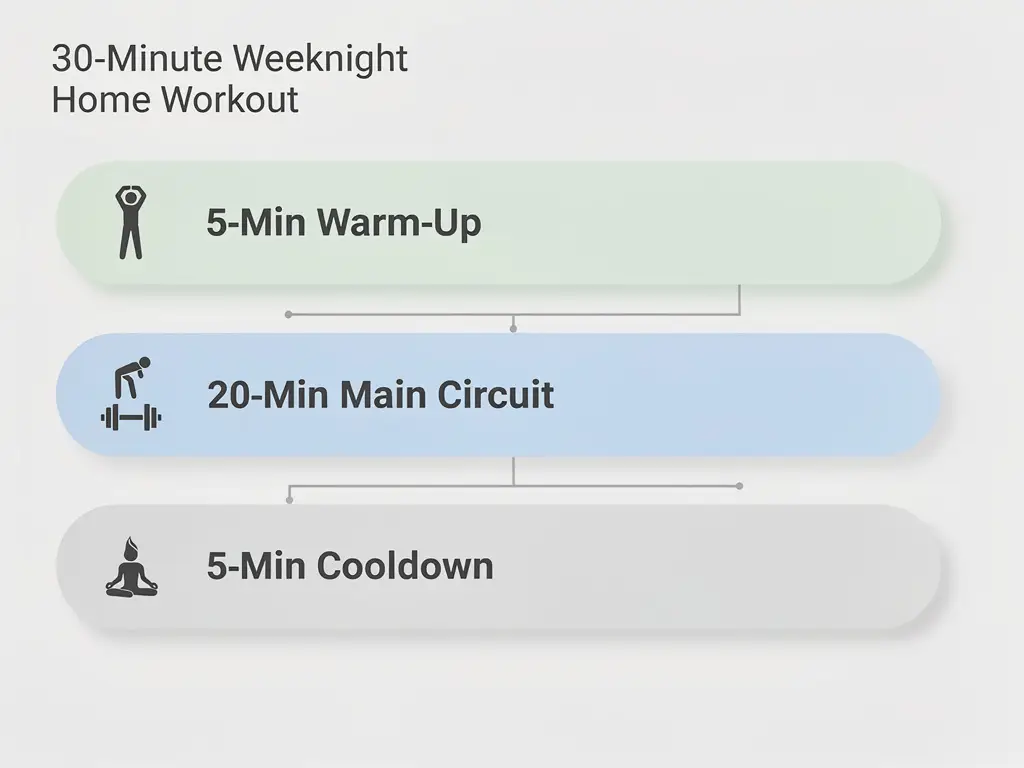
Workout Structure: 3-Round Circuit
Perform each movement for 45 seconds of focused, controlled effort, followed immediately by 15 seconds of complete rest (exactly 1 minute per station). Rest for 60 seconds after completing all 5 movements, then repeat for a total of 3 rounds.
- Warm-Up (2 Minutes): Spend 2 minutes preparing your joints with slow arm circles, torso rotations, and dynamic bodyweight squats.
- Station 1 (Squat Pattern): Bodyweight Air Squats (focusing on a controlled, 3-second descent).
- Station 2 (Push Pattern): Incline Couch Push-Ups (hands placed on the arm of your couch).
- Station 3 (Pull Pattern): Doorframe Rows (gripping the doorway frame, leaning back, and pulling forward).
- Station 4 (Hinge Pattern): Double-Leg Glute Bridges (actively squeezing your glutes at the top of the movement).
- Station 5 (Core Pattern): Static Plank Hold (keeping your abdominals fully braced).
- Cooldown (1 Minute): Spend 1 minute performing seated hamstring stretching and deep diaphragmatic breathing.
Master Your Evenings with FitSekai
If you are a FitSekai user, there is no need to manually coordinate exercises, track times, or write down rep schemes. We recommend launching Module #5 (Weeknights’ Burn).
This dual-track training module offers two progressive programs—No-Kit and Home Gym—specifically designed for busy evenings. Whether bodyweight-only or equipped, each session delivers efficient strength, cardio, and mobility in under 30 minutes, across three escalating phases.
FitSekai’s Smart Adaptive Training engine automatically processes your post-workout feedback, scaling your reps, hold times, and tempos for your next session to ensure you stay in the optimal adaptive zone.
Final Thought: Reclaim Your Rest
Your home is your sanctuary, and your physical health is your most valuable asset. By dedicating just 30 minutes to a structured weeknight routine, you can decompress from workday stress, protect your joint health, and transition smoothly into recovery.
📎 Read Next:
References & Further Reading
- McGill, S. M. (2024). Low Back Disorders: Evidence-Based Prevention and Rehabilitation (3rd ed.). Human Kinetics. [1].
- American College of Sports Medicine. (2024). ACSM’s Guidelines for Exercise Testing and Prescription (11th ed.). Wolters Kluwer. [2].
- Wood, W., & Rünger, D. (2016). Psychology of Habit. Annual Review of Psychology, 67, 289-314. [3].
- National Sleep Foundation. (2023). Sleep Duration Recommendations and Exercise. Retrieved from sleepfoundation.org. [4].
ID: 26032
Category: Home Workouts
Content Type: Deep Dives
Intent: Informational / Practical
Word Count: ~1,010 words
Reading Time: ~5 minutes
IMPORTANT LEGAL & CREATIVE DISCLAIMERS
Artificial Intelligence & Generation Disclosure
Please be advised that the written text, formatting structures, hierarchical organization, and creative image generation prompts contained in this guide were researched, structured, and produced with the assistance of advanced artificial intelligence technologies. While the raw narrative generation was AI-aided, all historical references, anatomical mechanisms, and scientific studies have been manually reviewed, cross-referenced, and verified for complete factual accuracy. All visual representations, graphic plans, and layout options are conceptual and have been generated with the assistance of artificial intelligence tools.
Health & Physical Activity Advisory
The information and educational materials provided in this guide are intended solely for general informational and learning purposes and do not constitute professional medical advice, clinical physiological diagnosis, or direct medical treatment. Engaging in any physical exercise program, particularly when utilizing modified home furniture or budget equipment, carries inherent risks of physical injury. It is strongly recommended that you consult with a qualified physician or certified healthcare professional before beginning any new training program, especially if you have pre-existing cardiovascular, metabolic, or musculoskeletal conditions. Stop exercising immediately if you experience pain, dizziness, or chest tightness.