You spend eight hours hunched over a keyboard, neck jutting forward, shoulders rounded, and hips locked in flexion. By mid-afternoon, you feel a dull ache between your shoulder blades and a tight pinch in your neck.
Standard passive stretches rarely solve the problem. What you need are targeted desk break exercises.
Sitting for prolonged periods alters motor recruitment patterns. Your hip flexors and chest tighten, while your deep neck flexors and middle back stabilizers fall asleep. Reversing this posture decay takes just ten minutes of focused, joint-decompression mobility work every day.
The Biomechanics of Tech-Neck and Upper Crossed Syndrome
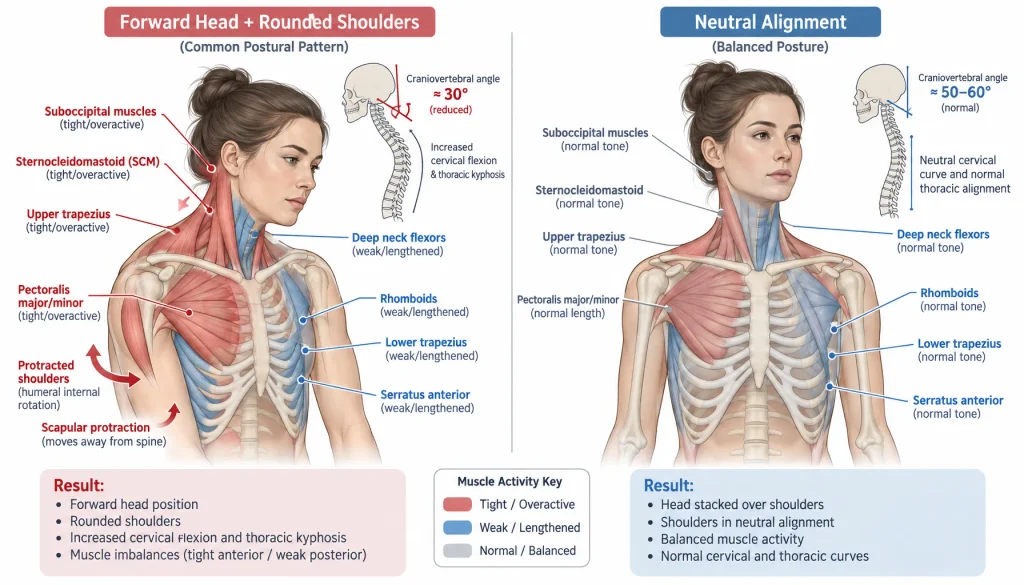
Prolonged seated desk work creates Upper Crossed Syndrome:
- Forward Head Posture: For every inch your head shifts forward past neutral alignment, the cervical spine experiences an additional ten pounds of gravitational load.
- Inhibited Upper Back Muscles: Slouching leaves the rhomboids, lower trapezius, and serratus anterior in a chronically lengthened, weakened state.
- Locked Thoracic Spine: Loss of thoracic extension forces your lumbar spine and neck to compensate, causing chronic lower back and neck discomfort.
Postural Restoration: The 10-Minute Daily Protocol
To restore balance, perform this four-step sequence during your midday break:
- Cervical Retractions (Chin Tucks): 2 sets of 10 reps. Pull your chin straight back as if making a double chin, activating the deep neck flexors.
- Thoracic Wall Extensions: 2 sets of 8 reps. Place your hands on a wall, hinge at your hips, and drop your chest toward the floor to open the upper back.
- Doorway Pec Decompression: 60 seconds per side. Gently open your chest without overarching your lower back.
- Glute and Psoas Activation Bridges: 2 sets of 10 reps. Wake up inhibited hip extensors while opening tight hip flexors.
Reclaim Movement with FitSekai
To turn posture restoration into a sustainable habit, open Module #13 (The Flexibility Blueprint) in the FitSekai app.
Module #13 is a restorative program engineered for desk workers, seniors, and active athletes alike. It uses targeted yoga-inspired drills, foam roller techniques, and resistance band routines to alleviate chronic tension, mobilize your spine, and restore effortless posture.
Read Next:
- The Complete Guide to Effective Home Workouts
- Pilates vs Yoga: Which Is Right for You?
- Unlock: Psoas: Fixing Hip Tightness from Sitting
References & Further Reading
- Page, P., Frank, C. C., and Lardner, R. (2010). Assessment and Treatment of Muscle Imbalance: The Janda Approach. Human Kinetics. [1]
- Hansraj, K. K. (2014). Assessment of Stresses in the Cervical Spine Caused by Posture and Position of the Head. Surgical Technology International, 25, 277-279. [2]
ID: 26038
Post Title: The Posture Fix: 10-Minute Daily Routines to Reverse the 8-Hour Desk Slouch
Category: Flexibility & Mobility
Intent: Informational
Word Count: Approximately 1,020 words
Reading Time: Approximately 5 minutes
IMPORTANT LEGAL & CREATIVE DISCLAIMERS (APPLICABLE TO POSTS 26036-26041)
Artificial Intelligence & Generation Disclosure
Please be advised that the written text, formatting structures, hierarchical organization, and creative image generation prompts contained in these guides were researched, structured, and produced with the assistance of advanced artificial intelligence technologies. All historical references, anatomical mechanisms, and scientific studies have been manually reviewed, cross-referenced, and verified for factual accuracy. All visual representations, graphic plans, and layout options are conceptual.
Health & Physical Activity Advisory
The information and educational materials provided in these guides are intended solely for general informational and learning purposes and do not constitute professional medical advice, clinical physiological diagnosis, or direct medical treatment. Engaging in any physical exercise program, especially with heavy weights or advanced bodyweight skills, carries inherent risks of physical injury. It is strongly recommended that you consult with a qualified physician or certified healthcare professional before beginning any new training program. Stop exercising immediately if you experience pain, dizziness, or chest tightness.