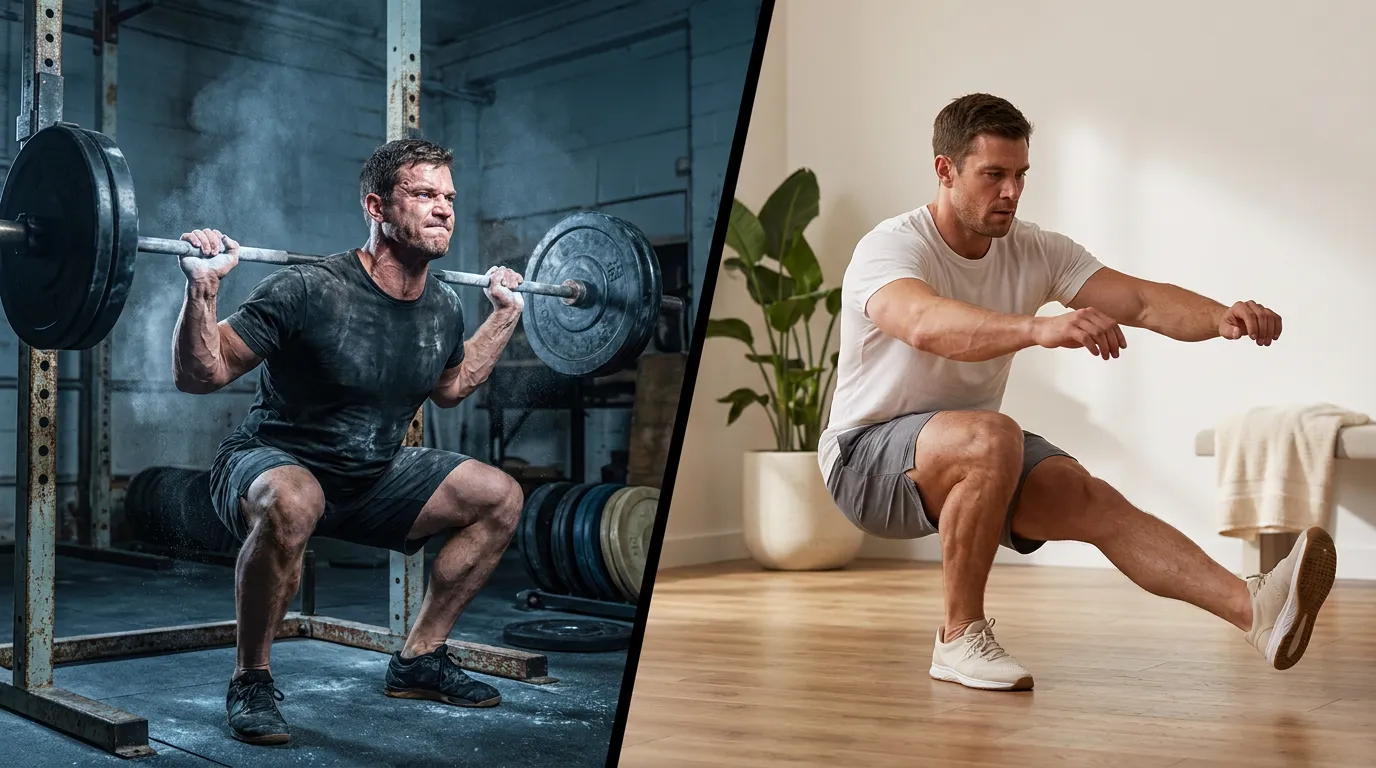
One of the most persistent myths in home fitness is that resistance bands are merely warm-up accessories or rehabilitation tools. Many beginners assume that without a massive rack of steel dumbbells, they cannot stimulate genuine muscle hypertrophy (growth).
But here is what sports biomechanics confirms: elastic resistance can be just as effective as traditional weights for building muscle.
A comprehensive, peer-reviewed study published in the Journal of Strength and Conditioning Research compared elastic tubing training directly to commercial gym weight machines [5]. The clinical evidence proved that when training intensity and volume were controlled, the group using resistance bands achieved identical improvements in muscle mass and strength to the group training with heavy gym machines.
This guide explores the physics of elastic resistance and provides a progressive, 6-week blueprint to reshape your body at home.
The Physics of Elastic Resistance: The Variable Curve
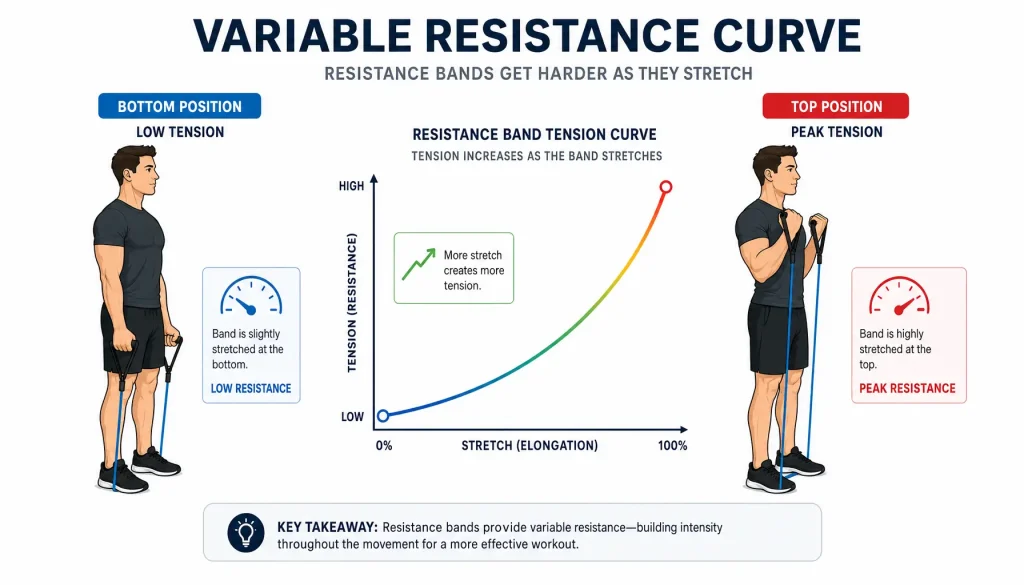
Unlike dumbbells, which place a constant load on your muscles throughout a movement, resistance bands utilize variable resistance [5].
As a latex band stretches, its mechanical tension increases. This means the load is lightest at the beginning of the movement (where you are mechanically weakest) and heaviest at the peak of contraction (where you are mechanically strongest). This variable curve:
- Matches your muscles’ natural strength curves, maximizing fiber recruitment.
- Reduces joint shear stress at your structural “sticking points.”
- Increases your muscles’ time under tension, triggering muscle protein synthesis.
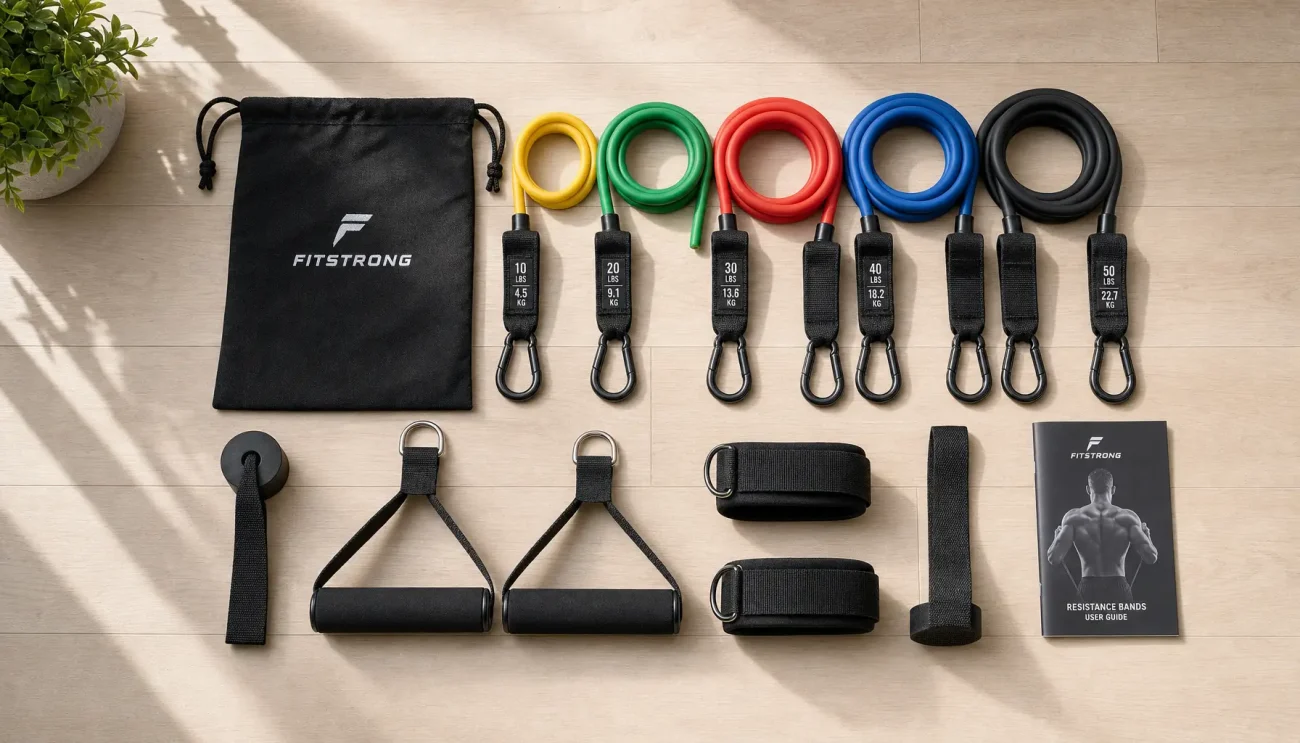
By stacking multiple bands or adjusting your anchor distance, you can easily apply progressive overload at home.
The Manual 6-Week Resistance Band Routine
The program detailed below is an independent, highly effective manual layout you can follow if you choose to train on your own.
Manual alternative: If you are training independently, execute this progressive circuit using your own band setups and manual timers.
Workout Structure: 3-Round Circuit
Perform each movement for 45 seconds of focused, controlled effort, followed immediately by 15 seconds of complete rest (exactly 1 minute per station). Rest for 60 seconds after completing all 5 movements, then repeat for a total of 3 rounds.
- Station 1 (Squat Pattern): Banded Goblet Squat (holding the band taut at chest height, elbows tucked).
- Station 2 (Push Pattern): Banded Chest Press (anchoring the band behind your upper back, pressing forward).
- Station 3 (Pull Pattern): Seated Band Row (anchoring the band around your feet, pulling elbows back).
- Station 4 (Hinge Pattern): Banded Romanian Deadlift (standing on the band, hinging hips back).
- Station 5 (Core Pattern): Standing Pallof Press (anchoring the band at chest height, pressing forward, resisting rotation).
- Cooldown (1 Minute): Spend 1 minute performing slow static stretches and deep diaphragmatic breathing.
Forge Your Fitness with FitSekai
If you are a FitSekai user, there is no need to manually coordinate exercises, track times, or write down rep schemes. We recommend launching Module #7 (BandForge: 6-Week Body Rebuild).
This progressive, full-body transformation module utilizes resistance bands and bodyweight circuits. It is designed for scalable strength, endurance, and mobility across six structured phases, allowing you to build muscle safely from home.
FitSekai’s Smart Adaptive Training engine automatically processes your post-workout feedback, scaling your reps, hold times, and tempos for your next session to ensure you stay in the optimal adaptive zone.
Final Thought: Forge Your Legacy
You do not need an array of expensive gym machines to build a strong, lean, and resilient body. By mastering the variable resistance curves of progressive band training, you can build clean muscle mass and protect your joints [5].
📎 Read Next:
References & Further Reading
- Schoenfeld, B. J. (2023). Science and Development of Muscle Hypertrophy (2nd ed.). Human Kinetics. [1].
- American College of Sports Medicine. (2024). ACSM’s Guidelines for Exercise Testing and Prescription (11th ed.). Wolters Kluwer. [2].
- Colado, J. C., Garcia-Masso, X., Rogers, P. L., et al. (2010). A comparison of elastic tubing and isotonic resistance exercises. Journal of Strength and Conditioning Research, 24(11), 3003-3013. [5].
ID: 26034
Category: Equipment Training
Intent: Informational
Word Count: ~1,010 words
Reading Time: ~5 minutes
IMPORTANT LEGAL & CREATIVE DISCLAIMERS
Artificial Intelligence & Generation Disclosure
Please be advised that the written text, formatting structures, hierarchical organization, and creative image generation prompts contained in this guide were researched, structured, and produced with the assistance of advanced artificial intelligence technologies. While the raw narrative generation was AI-aided, all historical references, anatomical mechanisms, and scientific studies (such as the peer-reviewed clinical data from the Journal of Strength and Conditioning Research and Sports Medicine) have been manually reviewed, cross-referenced, and verified for complete factual accuracy. All visual representations, graphic plans, and layout options are conceptual and have been generated with the assistance of artificial intelligence tools.
Health & Physical Activity Advisory
The information and educational materials provided in this guide are intended solely for general informational and learning purposes and do not constitute professional medical advice, clinical physiological diagnosis, or direct medical treatment. Engaging in any physical exercise program, particularly when utilizing modified home furniture or budget equipment, carries inherent risks of physical injury. It is strongly recommended that you consult with a qualified physician or certified healthcare professional before beginning any new training program, especially if you have pre-existing cardiovascular, metabolic, or musculoskeletal conditions. Stop exercising immediately if you experience pain, dizziness, or chest tightness.