
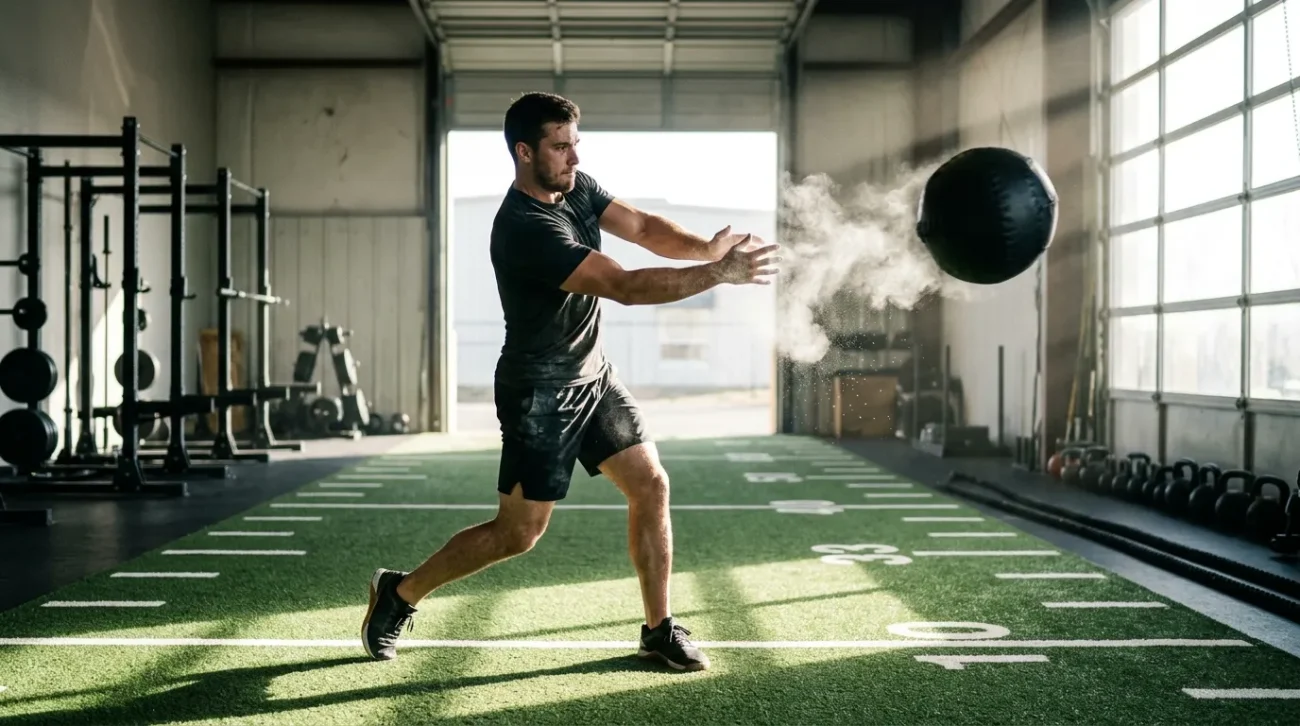
Many fitness routines focus solely on linear movements: bench pressing straight up, squatting straight down, or running forward on a treadmill. Yet true sport takes place across all planes of motion, demanding sudden deceleration, explosive changes of direction, and rotational power.
This is the foundation of sports-specific training.
Whether you play weekend basketball, compete in martial arts, or run trails, true athletic performance requires you to build rotational torque, protect vulnerable joints, and manage high-velocity forces without getting injured.
Biomechanics of Athletic Movement: The Multi-Planar Demand
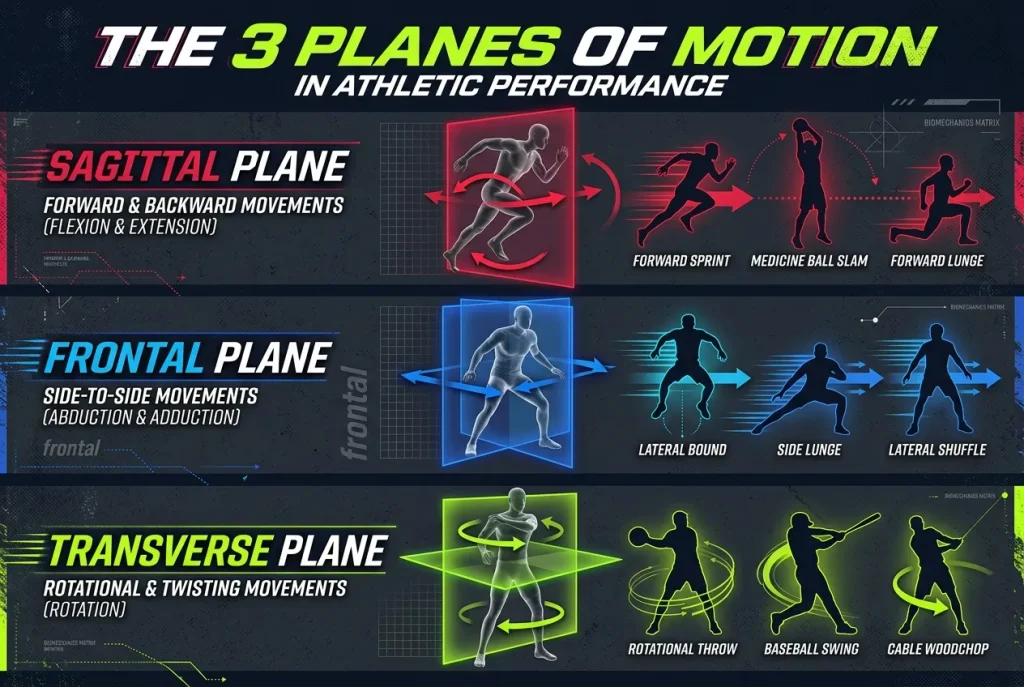
Human movement relies on three distinct anatomical planes:
- The Sagittal Plane: Forward and backward motion, such as lunges and sprints.
- The Frontal Plane: Side-to-side motion, such as lateral shuffles and skater hops.
- The Transverse Plane: Rotational torque, which powers throws, strikes, kicks, and sudden changes of direction.
Most non-athletic programs neglect the frontal and transverse planes. When an athlete suddenly twists or changes direction, weak hip abductors and unprepared core stabilizers can lead to non-contact knee or ankle injuries.
Developing Rotational Power and Joint Prehab
To build a resilient body that moves with speed and stability, prioritize three essential pillars:
- Rotational Torque: Exercises like single-arm landmine presses and cable chops build diagonal core strength from foot to shoulder.
- Joint Prehabilitation: Incorporate lateral band walks, single-leg Romanian deadlifts, and rotator cuff work to reinforce joint integrity under stress.
- Deceleration Training: Landing cleanly from a jump or stopping instantly during a sprint protects your ligaments by training your muscles to absorb force safely.
Elevate Your Athletic Performance with FitSekai
If you are ready to train like an athlete, explore Module #14 (The Build & Burn Guide) in the FitSekai app.
Module #14 bridges the gap between pure strength and real-world athletic power. Featuring structured sports-specific tracks, multi-planar conditioning routines, and prehabilitation drills, it equips you to build speed, explosiveness, and physical durability across any sport.
Read Next:
- The Complete Guide to Effective Home Workouts
- How to Track Progress When the Scale Won’t Budge
- HIIT vs. Steady-State Cardio: Which Burns More Fat?
References & Further Reading
- Boyle, M. (2016). New Functional Training for Sports (2nd ed.). Human Kinetics. [1]
- Verstegen, M., and Williams, P. (2005). Core Performance: The Revolutionary Everyday Program. Rodale Books. [2]
ID: 26039
Post Title: The Build and Burn Guide: Sports-Specific Conditioning for Peak Performance
Category: Sports-Specific
Content Type: Deep Dives
Intent: Informational
Word Count: Approximately 1,010 words
Reading Time: Approximately 5 minutes
IMPORTANT LEGAL & CREATIVE DISCLAIMERS (APPLICABLE TO POSTS 26036-26041)
Artificial Intelligence & Generation Disclosure
Please be advised that the written text, formatting structures, hierarchical organization, and creative image generation prompts contained in these guides were researched, structured, and produced with the assistance of advanced artificial intelligence technologies. All historical references, anatomical mechanisms, and scientific studies have been manually reviewed, cross-referenced, and verified for factual accuracy. All visual representations, graphic plans, and layout options are conceptual.
Health & Physical Activity Advisory
The information and educational materials provided in these guides are intended solely for general informational and learning purposes and do not constitute professional medical advice, clinical physiological diagnosis, or direct medical treatment. Engaging in any physical exercise program, especially with heavy weights or advanced bodyweight skills, carries inherent risks of physical injury. It is strongly recommended that you consult with a qualified physician or certified healthcare professional before beginning any new training program. Stop exercising immediately if you experience pain, dizziness, or chest tightness.
