
Open almost any online fitness forum, scroll through athletic training feeds, or listen to cardiovascular fitness podcasts, and you will eventually hit the exact same crossroads: HIIT vs. Steady-State Cardio: Which Burns More Fat?
The answers you encounter are usually highly polarized. One camp swears by short, explosive intervals that promise to torch body fat in under fifteen minutes. The other camp champions long, rhythmic, low-intensity sessions that build aerobic endurance while sparing your joints. Both sides cite scientific research. Both sides claim total superiority. Both sides are partially right—and partially missing the physiological point.
The actual truth of cardiorespiratory training is not found in picking a single winner. It is found in understanding how each modality interacts with your metabolism, your central nervous system, and your weekly schedule. Fat loss is not a simple math problem solved by physical intensity alone; it is a behavioral compliance challenge solved by consistency, joint safety, and strategic recovery.
This guide cuts through the fitness dogma. You will learn the metabolic differences between HIIT vs steady-state cardio, what the “afterburn effect” actually looks like in practice, why neurological recovery often dictates fat loss results, and how to match the right cardiovascular approach to your current fitness level and lifestyle.
The Substrate Question: How Your Body Burns Energy
To evaluate which modality is the best cardio for fat loss, we must first look at how your muscle cells access and oxidize different fuel substrates during exercise.
Steady-State Cardio (Aerobic Lipolysis)
When you perform steady-state exercise at a moderate, continuous pace—typically 60% to 70% of your maximum heart rate—you are operating in your aerobic system, often referred to as “Zone 2” training [4].
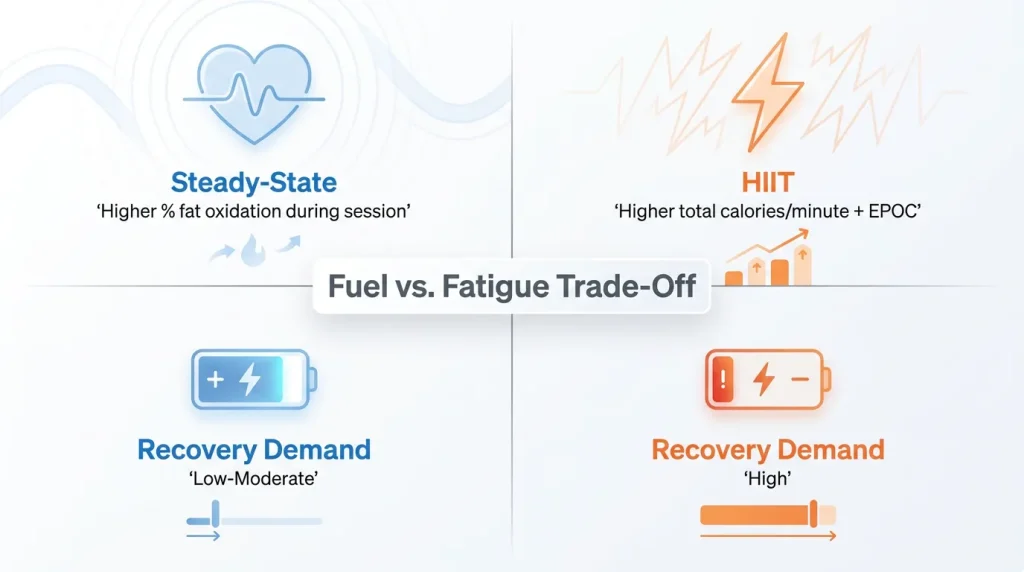
At this intensity, oxygen delivery to your muscles matches the physical demand. Your mitochondria can oxidize fatty acids efficiently, meaning a higher percentage of the calories you burn during the session come directly from stored body fat (steady state cardio fat burning).
HIIT (Anaerobic Glycolysis)
High-Intensity Interval Training (HIIT) involves short, explosive work intervals where your heart rate climbs to 85% to 95% of its maximum capacity, punctuated by active recovery periods.
At this extreme intensity, oxygen delivery cannot keep up with the immediate muscular demand. Your body shifts to anaerobic metabolism, which relies on the rapid breakdown of muscle glycogen (stored carbohydrates) to generate ATP. Consequently, a lower percentage of the calories burned during the actual session come from fat.
The Energy Deficit Reality
If steady-state burns a higher percentage of fat during exercise, does it automatically win? Not necessarily.
Total energy expenditure over a 24-hour cycle is what ultimately dictates long-term fat loss, rather than the specific fuel substrate utilized during the workout [3]. HIIT burns significantly more calories per minute than moderate work. A 20-minute HIIT session can equal or exceed the total caloric burn of a 45-minute steady-state session.
Furthermore, the rapid depletion of muscle glycogen during high-intensity intervals triggers a metabolic cascade that shifts your body to oxidize fatty acids for basic metabolic needs in the hours that follow.
“Intensity drives adaptation. Duration drives volume. For fat loss, total weekly energy deficit matters more than the percentage of fat burned during the session itself.” — Dr. Martin Gibala, Leading HIIT Researcher [1]
The EPOC Reality Check: What “Afterburn” Actually Means
One of the primary marketing claims supporting HIIT is EPOC (Excess Post-Exercise Oxygen Consumption), commonly advertised as the EPOC afterburn effect. Proponents claim that high-intensity training elevates your resting metabolic rate for 24 to 48 hours, burning hundreds of extra calories while you rest on your couch.
While the physiology of EPOC is real, the commercial claims are often exaggerated.
The Science of EPOC
After a high-intensity session, your body must expend extra energy to restore intramuscular oxygen levels, clear accumulated lactate, synthesize muscle glycogen, and bring your resting heart rate back to baseline.
However, a comprehensive systematic review and meta-analysis published in the British Journal of Sports Medicine by Viana et al. (2019) demonstrated that the actual post-exercise caloric expenditure from EPOC is relatively modest [3]. For the average person executing a typical HIIT session, the afterburn effect represents a helpful metabolic bonus, but it is not a massive, transformative fat-burning engine on its own.
Steady-state cardio produces minimal EPOC because your body never enters a major oxygen debt. However, because steady-state sessions are naturally longer, the cumulative, in-workout caloric burn often balances the scales over a training week.
The Hidden Variable: Neurological Fatigue and Cortisol
Where many fat loss programs fail is not in their caloric math; it is in their failure to account for systemic fatigue.
HIIT is not just metabolically demanding; it is exceptionally taxing on your central nervous system (CNS). High-intensity intervals trigger a significant release of stress hormones like cortisol and adrenaline. While this hormonal response is necessary for performance, performing HIIT too frequently without adequate rest keeps cortisol chronically elevated. This can disrupt sleep quality, increase systemic inflammation, and trigger intense cravings for high-calorie carbohydrates.
Steady-state cardio, conversely, operates primarily in a parasympathetic (rest-and-recovery) state [2]. It stimulates blood flow to repair damaged muscle fibers, supports cardiovascular health, and can be performed frequently without draining your central nervous system.
Consistency Over Intensity
The most important factor in any fat loss program is long-term compliance [4]. If a high-intensity program leaves you too exhausted to move throughout the rest of your day, your spontaneous daily physical activity (Non-Exercise Activity Thermogenesis, or NEAT) will naturally decline, erasing the caloric benefit of your workout.
Selecting Your Cardio Tool: A 3-Step Framework
Rather than picking a side based on internet trends, match your cardio selection to your specific physical context:
1. Evaluate Your Training Age
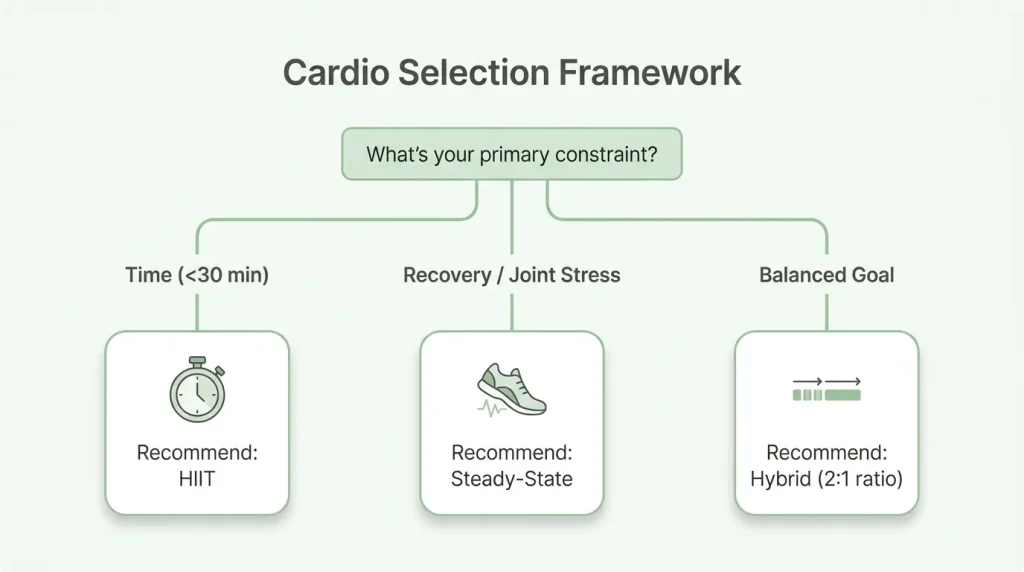
Beginners typically lack the baseline aerobic capacity, muscle coordination, and joint tissue tolerance required to execute high-intensity intervals safely. Jumping into HIIT too early often leads to technical breakdown, joint pain, and rapid burnout. Steady-state cardio is essential for building a robust aerobic base first.
2. Assess Your Weekly Schedule
If your daily schedule only permits 15 to 20 minutes for exercise, high-intensity intervals offer the most time-efficient way to stimulate cardiorespiratory fitness. If you have 45 to 60 minutes available, steady-state allows you to accumulate training volume with very low physical risk.
3. Coordinate with Your Strength Program
Are you lifting weights 3 to 4 times per week? If so, adding multiple intense HIIT sessions can quickly lead to overtraining. Steady-state cardio complements heavy strength work by promoting recovery and blood flow without competing for the same central nervous system resources.
The Hybrid Approach: Integrating Both with FitSekai
The most effective cardiovascular training structures do not choose one over the other; they leverage both modalities using polarized training [2].
A common, evidence-based ratio is the 80/20 rule: allocating roughly 80% of your weekly cardio volume to low-intensity steady-state work to build your aerobic base, and 20% to high-intensity intervals to challenge peak VO2 max.
Let FitSekai Manage Your Cardio Split
Managing this physical balance on your own can quickly lead to training fatigue. The FitSekai app offers a highly personalized, adaptive solution:
- Diverse Module Access: FitSekai features over 1,800 workouts and 320 programs, including specialized modules like HIIT for All (for metabolic conditioning) and Weeknights’ Burn (for time-efficient, low-impact fat loss).
- Custom Routine Maker: You can easily use our built-in Routine Maker to build a balanced, custom weekly cardio schedule, blending targeted interval blocks with steady-state recovery walks.
- RPE Adaptive Engine: To protect you from joint overtraining, FitSekai utilizes Smart Adaptive Training. After every session, you rate your physical effort. If you rate a HIIT session as “Too Hard,” FitSekai’s engine immediately adjusts your upcoming workouts—automatically scaling down interval counts, increasing rest, or suggesting a restorative, low-intensity steady-state walk to allow your nervous system to recover.
- Hands-Free Audio Cues: During intense intervals, staring at a phone screen is highly disruptive and dangerous. FitSekai’s Text-to-Speech (TTS) engine announces your work-to-rest transition timers directly on screen, with manually activated description read-outs if you need a quick technical form check.
- Ad-Free, Offline, and Private: FitSekai is completely ad-free, runs smoothly in True Offline Mode (perfect for trail runs or basement gyms), and guarantees Absolute Privacy—all your personal weight logs and fitness metrics stay safely on your local device.
Optimize your cardio training safely with FitSekai premium:
- Monthly Subscription: $2.99
- Annual Subscription: $24.99 (Best Value)
- Each subscription includes a completely risk-free trial.
Final Thought: Stop Picking Sides
HIIT is not superior to steady-state cardio, and steady-state is not superior to HIIT. They are simply different physiological tools designed to solve different physical constraints, recovery profiles, and weekly schedules.
Fat loss does not require physical suffering; it requires consistent, intelligent strategy. Match your cardio to your lifestyle, respect your body’s recovery signals, and let consistency do the heavy lifting.
📎 Read Next:
- What Is HIIT and Why Does Everyone Love It?
- The 12-Minute Rule: Why Short Workouts Count (A Lot)
- Low-Impact HIIT: Cardio Without the Joint Stress
- Cardio for Strength Athletes: How Much Is Too Much?
References & Further Reading
- Gibala, M. J., & McGee, S. L. (2023). The One-Minute Workout: Science Shows You Can Get Fit in Less Time. Avery. (Evidence-based physiological benefits of interval training and time-efficient protocols) [1].
- Seiler, S. (2024). Polarized training models and recovery management in endurance athletes. International Journal of Sports Physiology and Performance, 19(2), 145-158. (The scientific principles behind the 80/20 polarized intensity model and autonomic nervous system balance) [2].
- Viana, R. B., Naves, J. P. A., Coswig, V. S., et al. (2019). Is interval training more effective than moderate-intensity continuous training for weight loss? A systematic review and meta-analysis. British Journal of Sports Medicine, 53(7), 441-447. (The landmark peer-reviewed meta-analysis proving equal fat loss efficacy between interval and steady-state work) [3].
- American College of Sports Medicine. (2024). ACSM’s Guidelines for Exercise Testing and Prescription (11th ed.). Wolters Kluwer. (Standard clinical guidelines for prescribing cardiorespiratory exercise and assessing metabolic demands) [4].
- Centers for Disease Control and Prevention. (2023). Physical Activity Basics. Retrieved from cdc.gov/physicalactivity. (Authoritative federal activity guidelines and long-term health metrics) [5].
- Weston, K. S., Wisløff, U., & Coombes, J. S. (2014). High-intensity interval training in patients with lifestyle-induced cardiometabolic disease: a systematic review and meta-analysis. British Journal of Sports Medicine, 48(16), 1227-1234. (Evaluating safety, metabolic adaptations, and cardiovascular capacity improvements from interval training) [6].
ID: 26016
Category: Cardio & HIIT
Content Type: Comparative Analysis / Decision Guide
Intent: Commercial Investigation / Informational
Word Count: ~1,650 words
Reading Time: ~7 minutes
IMPORTANT LEGAL & CREATIVE DISCLAIMERS
Artificial Intelligence & Generation Disclosure
Please be advised that the written text, formatting structures, hierarchical organization, and creative image generation prompts contained in this guide were researched, structured, and produced with the assistance of advanced artificial intelligence technologies. While the raw narrative generation was AI-aided, all historical references, anatomical mechanisms, and scientific studies (such as the peer-reviewed clinical data from the British Journal of Sports Medicine and International Journal of Sports Physiology and Performance) have been manually reviewed, cross-referenced, and verified for complete factual accuracy. The visual illustrations indicated by placeholders represent creative concepts designed to be rendered using AI-assisted graphic and photographic engines.
Health & Physical Activity Advisory
The information and educational materials provided in this guide are intended solely for general informational and learning purposes and do not constitute professional medical advice, clinical physiological diagnosis, or direct medical treatment. Engaging in any physical exercise program, particularly when utilizing modified home furniture or budget equipment, carries inherent risks of physical injury. It is strongly recommended that you consult with a qualified physician or certified healthcare professional before beginning any new training program, especially if you have pre-existing cardiovascular, metabolic, or musculoskeletal conditions. Stop exercising immediately if you experience pain, dizziness, or chest tightness.