
Step into the fitness world, and you are immediately met with an overwhelming volume of options. Commercial gyms promote heavy lifting splits, local studios champion hot yoga and Pilates, online forums swear by high-intensity intervals, and running clubs advocate for long, steady miles.
Each camp claims their method is superior. If you try to do everything at once, you run directly into a state of systemic overtraining and physical fatigue.
Choosing the right workout program is not about finding the “best” exercise in absolute terms. It is about identifying the correct physiological stimulus required to solve your current physical goals, matching that stimulus to your weekly schedule, and respecting your body’s actual recovery capacity.
This guide provides an evidence-based decision framework to help you navigate different training styles—including strength, fat loss, mobility, and endurance—and outlines exactly how to select the right starting point for your body.
The Biological Rules of Adaptation: The SAID Principle
To choose a program effectively, you must understand the foundational law of exercise physiology: the SAID Principle (Specific Adaptation to Imposed Demands) [3].
Your body is highly efficient. It only adapts to the exact physical stress you place upon it.
- If you lift heavy weights, your body adapts by increasing motor unit recruitment and building denser muscle fibers (strength adaptation) [1].
- If you jog at a steady pace, your body adapts by increasing mitochondrial biogenesis and capillary density (aerobic endurance adaptation) [2].
You cannot expect a program built primarily around light cardio to build significant strength, nor can you expect a heavy, low-rep lifting program to optimize your cardiorespiratory VO2 max. You must define your primary goal first, and align your training modality to target that specific pathway.
The Four Primary Training Modalities (Decoded)
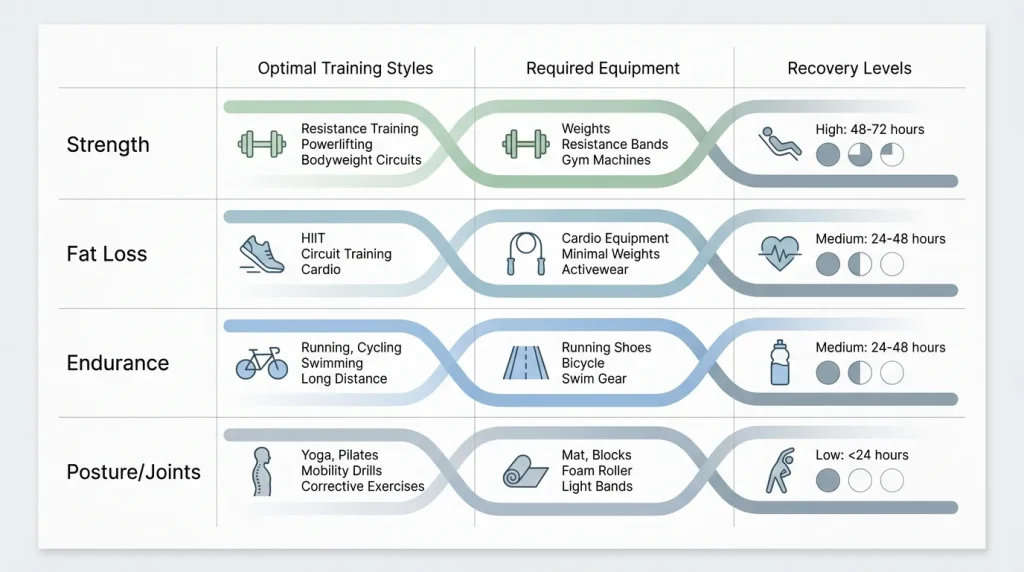
Use this functional breakdown to align your primary goal with the correct scientific training style:
1. Strength & Hypertrophy (Musculoskeletal Focus)
- Primary Stimulus: High mechanical tension [1].
- How it works: Moving a challenging external load (using dumbbells, barbells, or bands) through a full range of motion.
- Best for: Building lean muscle mass, increasing bone mineral density, improving posture, and safeguarding joints from injury.
2. Metabolic Conditioning & Fat Loss (Systemic Deficit Focus)
- Primary Stimulus: High total energy expenditure and metabolic stress.
- How it works: High-density circuits, interval training (HIIT), or hybrid resistance complexes.
- Best for: Driving a caloric deficit, improving metabolic flexibility, and boosting post-workout oxygen consumption (EPOC).
3. Cardiorespiratory Endurance (Aerobic Base Focus)
- Primary Stimulus: Sustained oxygen demand and stroke volume adaptations.
- How it works: Low-intensity steady-state cardio (Zone 2 work like cycling, rowing, or running) [4].
- Best for: Heart health, reducing resting blood pressure, enhancing recovery, and building an endurance foundation.
4. Mobility, Posture, & Joint Care (Myofascial Focus)
- Primary Stimulus: Controlled joint articulation and tissue elongation.
- How it works: Yoga, Pilates, dynamic stretching, and active joint decompression.
- Best for: Releasing chronic muscle tightness, correcting pelvic alignment, and speeding up recovery between heavy training sessions.
The Program Selection Framework
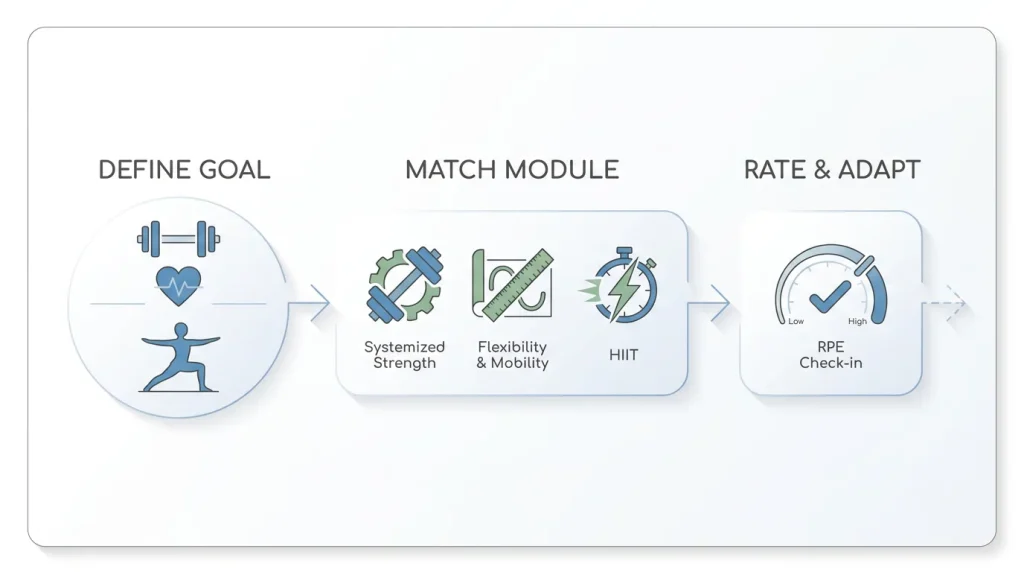
To select your ideal program, run your training decisions through these three practical filters:
Filter 1: Identify Your Primary Constraint
What is your primary limitation?
- Limited Time (<30 mins per session): Prioritize high-density interval training (HIIT) or efficient full-body strength circuits.
- Sensitive Joints or Chronic Pain: Prioritize low-impact bodyweight work, active mobility, or targeted joint prehabilitation.
- High Work Stress / Poor Sleep: Avoid high-intensity HIIT or heavy powerlifting splits. Focus on low-stress Zone 2 cardio, yoga, or basic full-body habit building.
Filter 2: The Concurrent Training Reality
Many lifters want to build maximum strength and maximum aerobic endurance simultaneously. While this is possible (known as concurrent training), high volumes of intensive cardio can trigger the interference effect, blunting your strength and muscle gains [1]. If absolute strength is your goal, keep your cardio volume moderate (under 90 minutes per week) and low-impact [4].
Seamless Navigation: Program Selection with FitSekai
If you are overwhelmed by trying to build your own weekly routine, utilizing a structured digital library can help remove the friction of program selection.
Within the FitSekai app, we have categorized our library of over 320 programs and 1,800 workouts into specialized Modules designed precisely to match your physical goals:
- For Strength & Muscle Growth: Strive to build a solid physical foundation by launching Module #56 (Total Body 101) or Module #12 (Dumbbell Burn System). These modules use progressive resistance and controlled tempos to drive structural hypertrophy safely.
- For Low-Impact Cardio & Fat Loss: To elevate your heart rate and burn energy without joint pounding, select Module #9 (HIIT for All: Beginner) or Module #10 (HIIT for All: Intermediate).
- For Joint Care & Mobility: If your body is feeling stiff from prolonged sitting or heavy lifting, select Module #13 (The Flexibility Blueprint) or Module #49 (Unlock: Psoas) to decompress your joints and accelerate muscular recovery.
By utilizing FitSekai’s built-in Routine Maker, you can easily mix, match, and arrange workouts from these diverse modules to create a highly personalized, weekly hybrid schedule that perfectly balances strength, cardio, and active recovery.
Final Thought: Build Your Foundation First
You do not need to follow a complex, elite athlete’s program to achieve a healthy, resilient body.
Start by identifying your primary goal, choose a single, focused module that matches your schedule, and commit to showing up consistently [4]. Allow your body to master the fundamental movement patterns before attempting to add complexity.
📎 Read Next:
- Strength Training 101: A Complete Beginner’s Guide
- Progressive Overload: The Key to Getting Stronger
- What Actually Happens to Your Body in the First 30 Days of Exercise
- How to Build a Workout Habit When You’ve Never Exercised
References & Further Reading
- Schoenfeld, B. J., Grgic, J., Ogborn, D., & Krieger, J. W. (2017). Strength and hypertrophy adaptations between low- vs. high-load resistance training: a systematic review and meta-analysis. Journal of Strength and Conditioning Research, 31(12), 3508-3523. (Physiological mechanisms of muscle growth and structural strength) [1].
- American College of Sports Medicine. (2024). ACSM’s Guidelines for Exercise Testing and Prescription (11th ed.). Wolters Kluwer. (Standard clinical guidelines for physical activity, cardiorespiratory endurance, and load progression safety) [2].
- National Strength and Conditioning Association. (2024). Essentials of Strength Training and Conditioning (5th ed.). Human Kinetics. (Biomechanical breakdown of human movement patterns, programming, and the SAID principle) [3].
- Schumann, M., Feuerbacher, J. F., Sünkeler, M., et al. (2022). Compatibility of Concurrent Aerobic and Strength Training for Skeletal Muscle Size and Function: An Updated Systematic Review and Meta-Analysis. Sports Medicine, 52(3), 601-612. (Peer-reviewed meta-analysis on balancing cardio and strength to avoid the interference effect) [4].
ID: 26023
Post Title: How to Choose a Program: Fat Loss vs. Strength vs. Mobility vs. Endurance
Category: Programming
Content Type: Practical Decision Framework
Intent: Informational / Practical
Word Count: ~1,510 words
Reading Time: ~7 minutes
IMPORTANT LEGAL & CREATIVE DISCLAIMERS
Artificial Intelligence & Generation Disclosure
Please be advised that the written text, formatting structures, hierarchical organization, and creative image generation prompts contained in this guide were researched, structured, and produced with the assistance of advanced artificial intelligence technologies. While the raw narrative generation was AI-aided, all historical references, anatomical mechanisms, and scientific studies (such as the peer-reviewed clinical data from the Journal of Strength and Conditioning Research and Sports Medicine) have been manually reviewed, cross-referenced, and verified for complete factual accuracy. All visual representations, graphic plans, and layout options are conceptual and have been generated with the assistance of artificial intelligence tools.
Health & Physical Activity Advisory
The information and educational materials provided in this guide are intended solely for general informational and learning purposes and do not constitute professional medical advice, clinical physiological diagnosis, or direct medical treatment. Engaging in any physical exercise program, particularly when utilizing modified home furniture or budget equipment, carries inherent risks of physical injury. It is strongly recommended that you consult with a qualified physician or certified healthcare professional before beginning any new training program, especially if you have pre-existing cardiovascular, metabolic, or musculoskeletal conditions. Stop exercising immediately if you experience pain, dizziness, or chest tightness.
