You’ve decided to start exercising. That’s huge.
But if you’re like most beginners, you’re also worried: What if I start strong and then quit? What if I can’t stick with it?
Here’s the truth: Consistency isn’t about willpower. It’s about systems.
Research consistently shows that building a new habit takes time and systematic repetition—not heroic, short-lived bursts of extreme motivation. The good news? Building an exercise habit is a highly learnable skill. And once it is wired into your daily routine, movement stops feeling like a chore and starts feeling like part of who you are.
This guide walks you through the behavioral science of habit formation and provides a practical, step-by-step framework to make exercise stick—for good.
Why Willpower Fails (And What Works Instead)
Most people approach fitness like this: I will simply push harder. I will try to be more disciplined.
But willpower is a finite cognitive resource. A well-cited study published in the European Journal of Social Psychology (Lally et al., 2009) tracked habit formation in real-world settings and found that the time for a new behavior to become automatic varied widely—ranging from 18 to 254 days—with an average of about 66 days [1].
The takeaway is not the exact number of days; it is this: habits require structured, low-friction repetition, not flawless perfection.
“You do not rise to the level of your goals. We fall to the level of your systems.” — James Clear, Author of Atomic Habits [4]
The problem is not your dedication; it is your approach. Instead of relying on unreliable bursts of motivation, you must build a daily system that makes showing up your default behavior. Here is how.
The 3-Part Habit Loop (And How to Hack It)
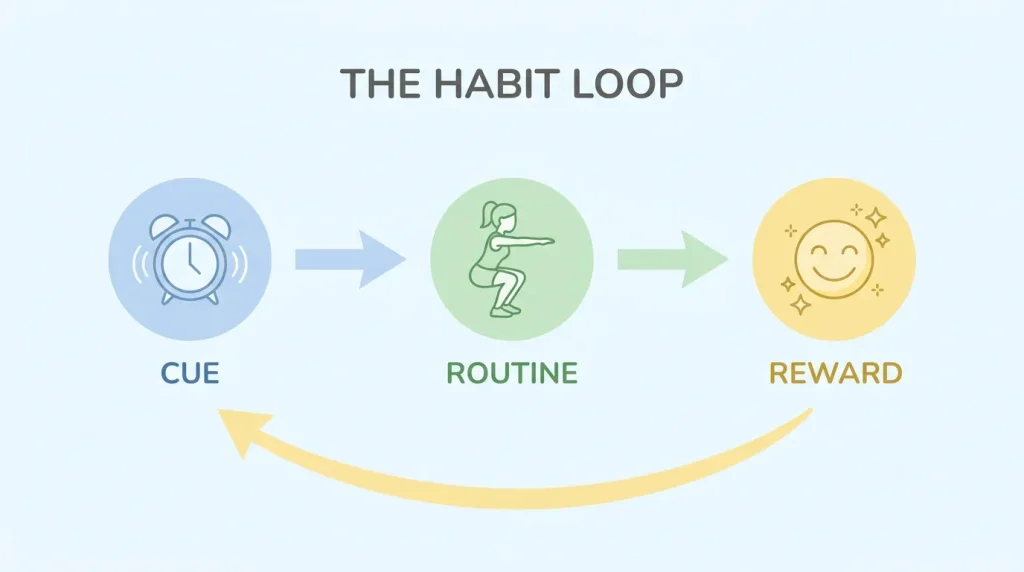
Every physical or mental habit follows a recognizable neurological pattern consisting of three phases:
- The Cue (The Trigger): The prompt that initiates the behavior (e.g., your morning alarm goes off).
- The Routine (The Workout): The actual physical behavior or exercise session.
- The Reward (The Positive Feedback): The benefit your brain registers (e.g., a rush of endorphins or a sense of accomplishment).
To build a sustainable workout habit, you need to engineer each of these three phases intentionally:
Step 1: Make the Cue Obvious
Do not leave your workout to chance or wait for a free window to appear. Anchor your training to an existing, automatic habit—a behavioral strategy called habit stacking.
- “After I pour my morning coffee, I will do 5 minutes of basic stretching.”
- “After I change out of my work clothes, I will do my 12-minute workout.”
- “After I brush my teeth at night, I will do 3 minutes of mobility work.”
Research on “implementation intentions” by psychologist Peter Gollwitzer shows that individuals who form specific, situational plans (“If X happens, then I will do Y”) are significantly more likely to follow through on their long-term goals compared to those with vague intentions [2].
Step 2: Make the Routine Easy (Especially at First)
The primary reason beginners fail is starting too big. They attempt a grueling 45-minute high-intensity session on Day 1, wake up too sore to move on Day 2, and slide into guilt and cancellation by Day 3.
Instead, follow The Two-Minute Rule [4]. Scale your new exercise habit down to something so small it feels almost effortless to start:
- Want to run? Start with: “Put on my running shoes and step outside.”
- Want to strength train? Start with: “Do 2 bodyweight squats.”
- Want to do yoga? Start with: “Unroll my mat and take 3 deep breaths.”
“People change best by feeling good, not by feeling bad.” — Dr. BJ Fogg, Founder of the Behavior Design Lab at Stanford University [3]
The goal of your first week is not to get an exhausting workout; the goal is to wire the psychological identity: “I am a person who does not miss workouts.” Once the habit is established, you can scale the intensity. But you cannot scale a habit that has never started.
Step 3: Make the Reward Immediate
Your brain naturally prioritizes immediate neurological rewards over distant, abstract benefits. The goal of “losing 20 pounds in six months” feels too distant to drive behavior today. A feeling of immediate energy, however, is highly reinforcing.
You can hack the reward loop by:
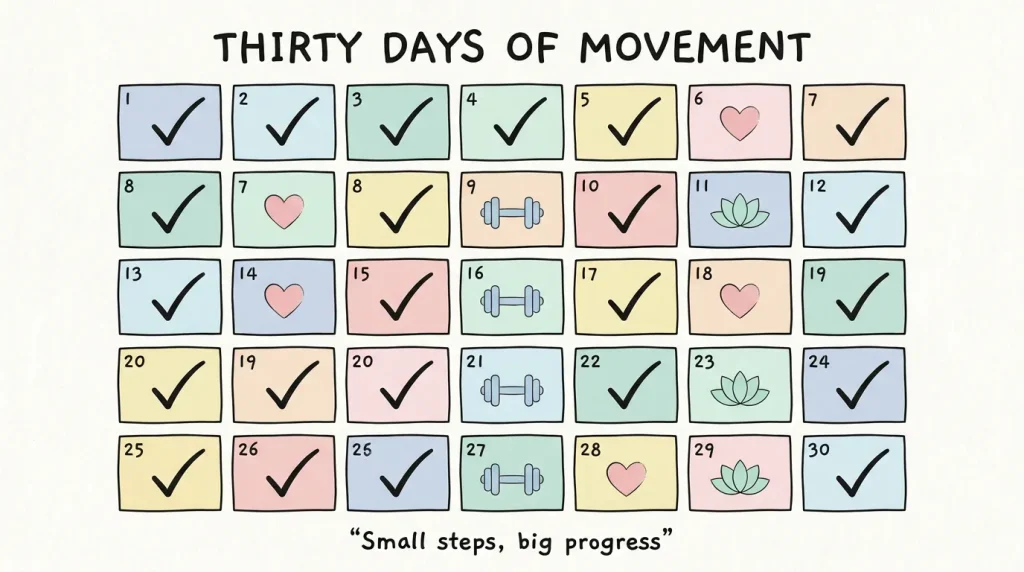
- Tracking your progress visually: Checking off a box on a calendar provides a small, immediate sense of accomplishment.
- Focusing on post-workout sensations: Pay close attention to how you feel immediately after movement (more alert, less stressed, less stiff) and mentally call it out.
The Identity Shift: From “I Should” to “I Am”
Lasting behavioral change only occurs when your daily actions align with your internal identity.
- Instead of saying: “I am trying to work out.”
- Try saying: “I am a person who prioritizes daily movement.”
This subtle cognitive shift changes how you negotiate with yourself. When exercise is part of your identity rather than a chore on a to-do list, showing up becomes automatic.
To reinforce this identity, surround your environment with positive physical cues. Keep your workout clothes visible, place your exercise mat where you see it first thing in the morning, and protect your training window from external demands. As habit researcher Dr. Wendy Wood notes, repeating a behavior in a consistent context strengthens the automatic association between the cue and the action [5].
What to Do When You Miss a Day (Because You Will)
Perfectionism is the enemy of habit building. You will eventually miss a workout due to travel, work stress, or illness. That is not a failure; it is normal life.
Follow The “Never Miss Twice” Rule [4]:
If you miss one day, your only priority is to show up the next day. Do not feel guilty, and do not try to “make up” for the missed session by training twice as hard. Simply reset the habit immediately.
Flexible Scheduling with FitSekai
To support this mindset, the FitSekai app features an incredibly flexible scheduling engine. If life gets busy, you can easily reschedule workouts on your calendar without breaking your active training streak or ruining your consistency heatmap. When your training program bends to fit your life rather than demanding your life adapt to it, consistency becomes sustainable.
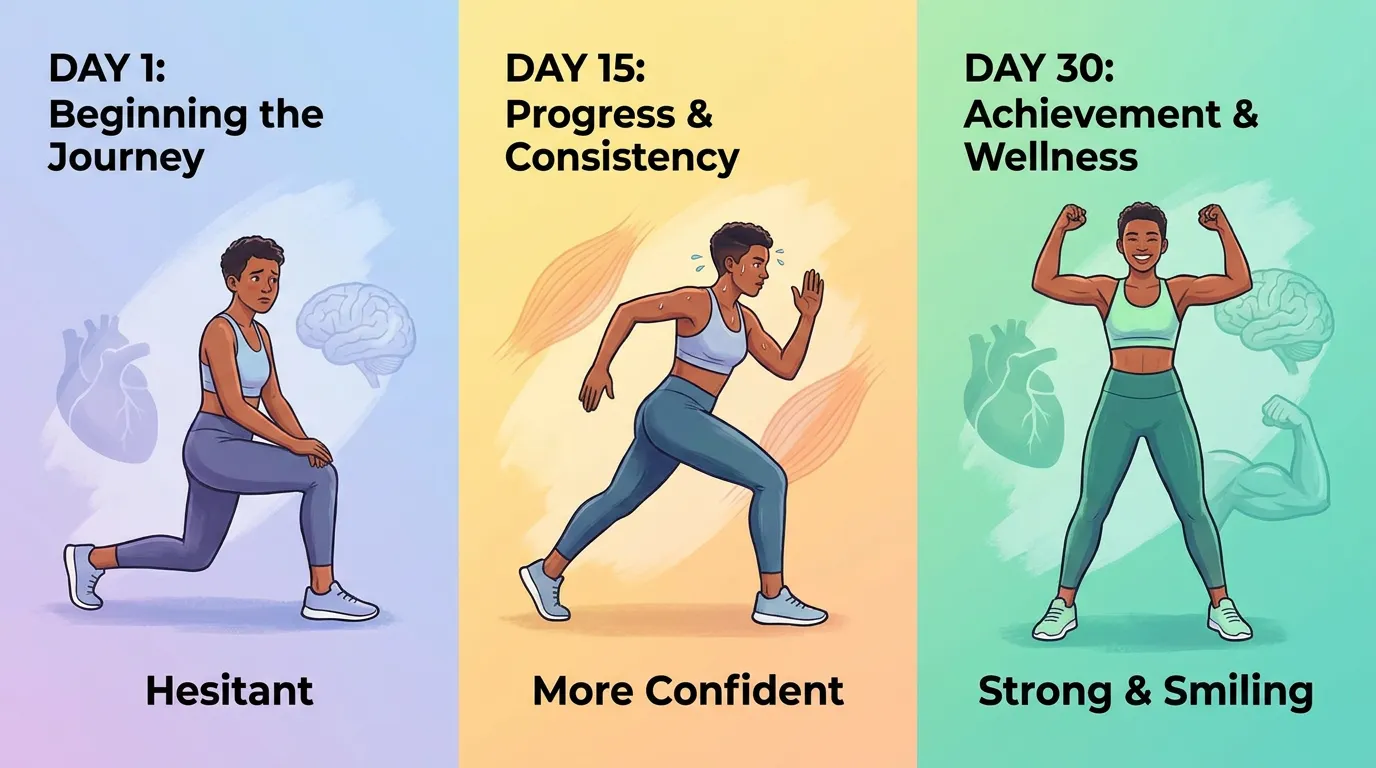
Your 30-Day Habit-Building Roadmap
The weekly steps outlined below are an independent, highly effective manual roadmap you can follow if you choose to train on your own.
App Integration Tip: If you want to automate this process without manual tracking, we recommend launching Module #1: FitStart Home (Tagline: Start strong. Stay home. Feel better.).
Designed specifically for beginners, this equipment-light module features 10 standalone workouts, such as FitStart Home Warmup, FitStart Home Fullbody, and FitStart Home Cooldown. Using the app’s intuitive Routine Maker, you can easily mix, match, and organize these brief sessions to fit your exact weekly recovery capacity.
- Week 1: Anchor the Cue. Pick one daily trigger (e.g., after your morning coffee). Execute a 2-to-5 minute movement routine (light stretching or 3 basic bodyweight exercises). Log it immediately. Focus purely on showing up—not on intensity or duration.
- Week 2: Expand Slightly. Increase your movement window to 8 to 10 minutes. Add one new movement to your routine. Notice and name one positive feeling after every session (“I feel calmer,” “My lower back feels looser”).
- Week 3: Introduce Variety. Try two different types of movement (e.g., one day focused on light strength, one day on mobility). Keep your sessions under 15 minutes, and experiment to find your optimal time of day to train.
- Week 4: Solidify the Identity. Reflect on your consistency. You have successfully moved your body 12+ times this month. Share a physical win with a supportive friend, and plan one small progression for month two.
When Adaptive Support Can Help
If you have tried to build a fitness habit in the past and struggled, you are not broken. You may simply need a system that adapts to your daily life:
- Energy Variability: If your daily energy is highly fluctuating, a rigid, static workout program can feel frustrating.
- Feedback Loops: Within the FitSekai app, you can rate your physical effort (Too Easy / Just Right / Too Hard) after every session. Our Smart Adaptive Training engine immediately processes this feedback, automatically scaling reps, holds, and tempos for your next workout to ensure you are challenged without feeling physically crushed.
Final Thought: Start Small, Become Someone New
Building a workout habit is not about transforming your body overnight; it is about transforming your relationship with daily movement.
You do not need to be perfect, and you do not need to do it all at once. You simply need to show up—small, consistent, and kind to your joints.
Do two minutes today. Then, do it again tomorrow. That is how physical habits are built, and that is how lasting change happens.
📎 Read Next:
- The Ultimate Beginner’s Guide to Making Fitness a Lifestyle
- Why Your First Workout Doesn’t Have to Be Perfect
- What Actually Happens to Your Body in the First 30 Days
- The 12-Minute Rule: Why Short Workouts Count (A Lot)
References & Further Reading
- Lally, P., van Jaarsveld, C. H. M., Potts, H. W. W., & Wardle, J. (2010). How are habits formed: Modelling habit formation in the real world. European Journal of Social Psychology, 40(6), 998-1009. (The seminal study on real-world habit automaticity and timelines) [1].
- Gollwitzer, P. M. (1999). Implementation intentions: Strong effects of simple plans. American Psychologist, 54(7), 493-503. (Foundational research on the power of situational planning) [2].
- Fogg, B. J. (2020). Tiny Habits: The Small Changes That Change Everything. Houghton Mifflin Harcourt. (Practical behavioral frameworks for starting small) [3].
- Clear, J. (2018). Atomic Habits: An Easy & Proven Way to Build Good Habits & Break Bad Ones. Avery. (Strategies for building systems and establishing identity) [4].
- Wood, W., & Rünger, D. (2016). Psychology of Habit. Annual Review of Psychology, 67, 289-314. (A comprehensive meta-analysis of behavioral cues and environment design in habit formation) [5].
- Centers for Disease Control and Prevention. (2023). Physical Activity Basics. Retrieved from cdc.gov/physicalactivity. (Standard federal physical guidelines for health and disease prevention) [6].
- American College of Sports Medicine. (2021). ACSM’s Guidelines for Exercise Testing and Prescription (11th ed.). Wolters Kluwer. (Evidence-based clinical guidelines for progressive exercise adaptation) [7].
ID: 26002
Category: Beginner Fitness
Content Type: Practical Guide / Behavior Science
Intent: Informational / Practical
Word Count: ~1,410 words
Reading Time: ~6 minutes
IMPORTANT LEGAL & CREATIVE DISCLAIMERS
Artificial Intelligence & Generation Disclosure
Please be advised that the written text, formatting structures, hierarchical organization, and creative image generation prompts contained in this guide were researched, structured, and produced with the assistance of advanced artificial intelligence technologies. While the raw narrative generation was AI-aided, all historical references, anatomical mechanisms, and scientific studies (such as the peer-reviewed clinical data from the European Journal of Social Psychology and Annual Review of Psychology) have been manually reviewed, cross-referenced, and verified for complete factual accuracy. All visual representations, graphic plans, and layout options are conceptual and have been generated with the assistance of artificial intelligence tools.
Health & Physical Activity Advisory
The information and educational materials provided in this guide are intended solely for general informational and learning purposes and do not constitute professional medical advice, clinical physiological diagnosis, or direct medical treatment. Engaging in any physical exercise program, particularly when utilizing modified home furniture or budget equipment, carries inherent risks of physical injury. It is strongly recommended that you consult with a qualified physician or certified healthcare professional before beginning any new training program, especially if you have pre-existing cardiovascular, metabolic, or musculoskeletal conditions. Stop exercising immediately if you experience pain, dizziness, or chest tightness.