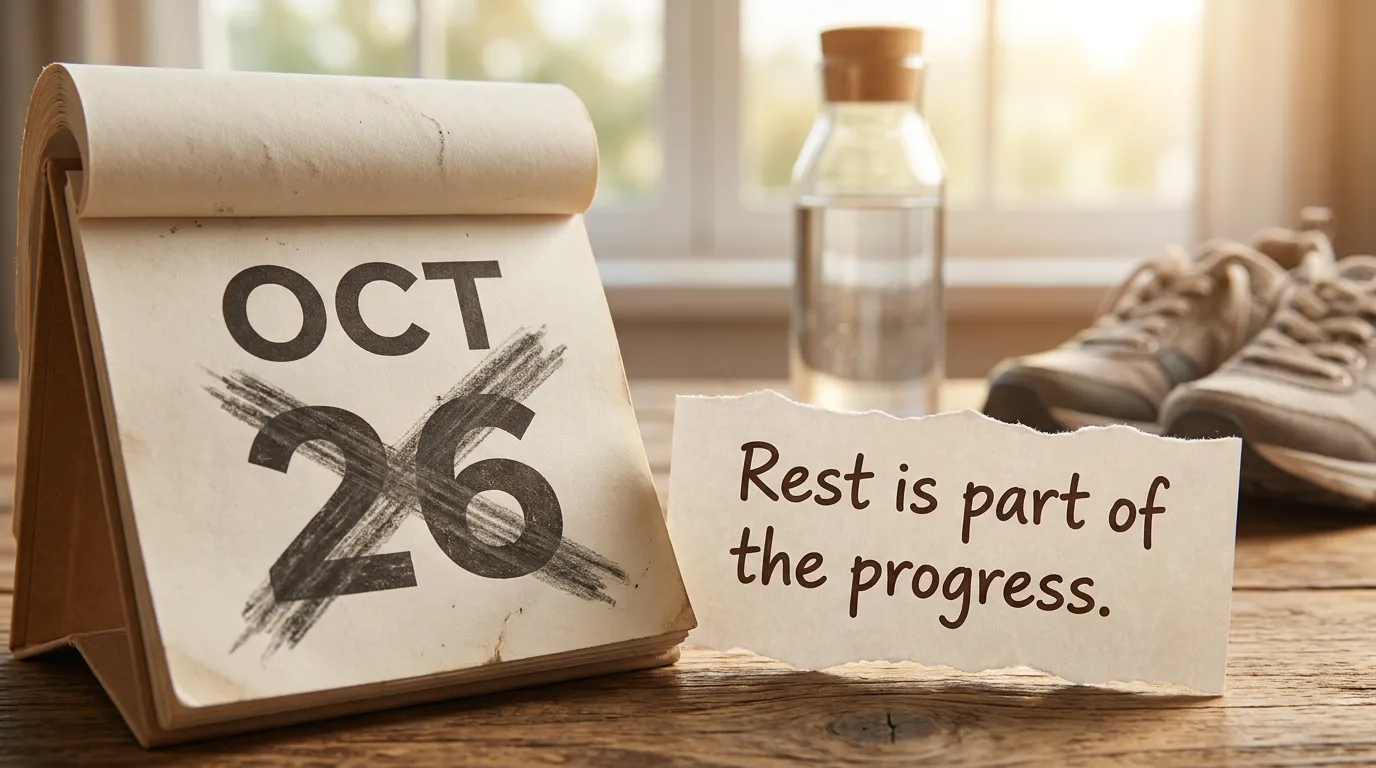
You had every intention of showing up today. You packed your gear, blocked out your schedule, and set your alarm. But then, life intervened. A late meeting at work, a sick child, a poor night of sleep, or simply a wave of overwhelming fatigue left your plans in ruins. So, what to do when you miss a workout?
If you are like most fitness enthusiasts—especially those in the early stages of building a routine—your immediate response is likely a mix of frustration, anxiety, and guilt. You might feel as though you have erased weeks of hard work, or that your entire program is slipping away.
This psychological barrier is one of the most common hurdles to long-term fitness consistency.
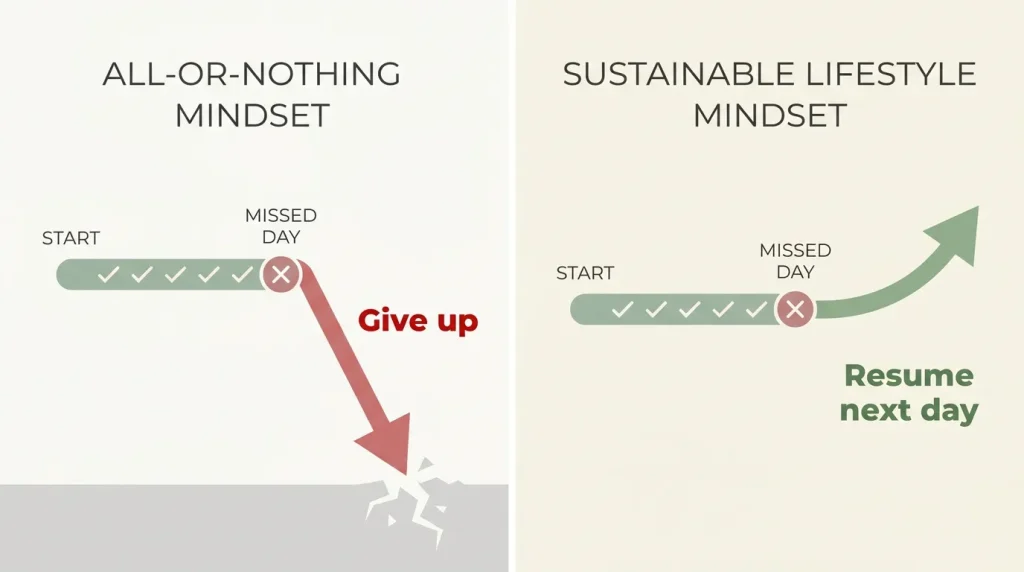
In behavioral psychology, this is known as the Abstinence Violation Effect, colloquially termed the “What the Hell” effect [1]. It describes a pattern where a minor slip-up (like missing one workout) triggers a sense of personal failure, causing the individual to completely abandon their routine because the “perfect” streak has been broken.
This guide explores the science behind habit disruptions, explains why a single missed session has virtually zero impact on your physical progress, and outlines a practical, no-guilt protocol to resume your routine sustainably.
The Physiology of a Missed Workout: What Actually Happens?
To free yourself from the anxiety of a missed session, it is helpful to understand how slowly your body actually deconditions:
1. Muscular Strength is Resilient
You do not lose strength or muscle tissue (atrophy) from missing a workout, or even from taking a full week off. Sports science research consistently demonstrates that significant muscle atrophy and strength loss only begin after 14 to 21 days of complete physical inactivity [5].
The early strength gains you make as a beginner are primarily neurological—meaning your brain is learning to recruit motor units more efficiently. These neurological pathways are highly stable and do not degrade from a brief pause.
2. Cardiovascular Efficiency is Easily Restored
While cardiorespiratory endurance (VO2 max) can begin to decline slightly after 7 to 10 days of complete rest, this decline is minor (often under 5%) and is rapidly restored within one or two active sessions. A single missed cardio day has no measurable impact on your aerobic base or heart health [2].
3. Active Recovery is Occurring
Sometimes, a missed workout is your body’s self-preservation mechanism. If you are experiencing high work stress, sleep deprivation, or physical fatigue, forcing an intense training session can drive up your cortisol levels, prolonging recovery and increasing your risk of joint injury.
In this context, an unscheduled rest day can act as active recovery, allowing your hormone levels to balance and your joint structures to repair [3].
The “No-Panic” Protocol: How to Resume Safely
When you miss a session, follow this step-by-step protocol to get back on track without guilt or physical overcompensation:
Step 1: Apply the “Never Miss Twice” Rule
The single most important rule of habit consistency is never miss twice [4].
Missing one workout is an isolated event; missing two workouts in a row is the beginning of a new, sedentary habit. Do not worry about the session you missed. Focus entirely on showing up for your very next scheduled training block.
Step 2: Avoid the “Overcompensation” Trap
A common beginner mistake is trying to “make up” for a missed workout by doubling the intensity or length of their next session.
If you missed a 30-minute squat workout on Tuesday, do not try to perform a grueling 60-minute session on Thursday. This extreme spike in training volume increases your systemic fatigue and joint stress, often leading to severe muscle soreness that forces you to miss even more workouts. Simply perform your next scheduled workout exactly as planned.
Step 3: Lower the Barrier to Entry
If you missed a session because you are still feeling exhausted, busy, or stressed, do not force yourself through a massive routine. Instead, scale down the entry barrier.
Tell yourself: “I will just do 5 minutes of stretching.” Once you begin moving, you will often find the physical momentum carries you forward. But even if you stop after 5 minutes, you have successfully kept the habit loop alive.
Leveraging FitSekai for Habit Recovery
If you find yourself struggling with the mental friction of a disrupted schedule, utilizing a flexible tracking system can remove the anxiety of starting over:
The Adaptive Calendar Engine
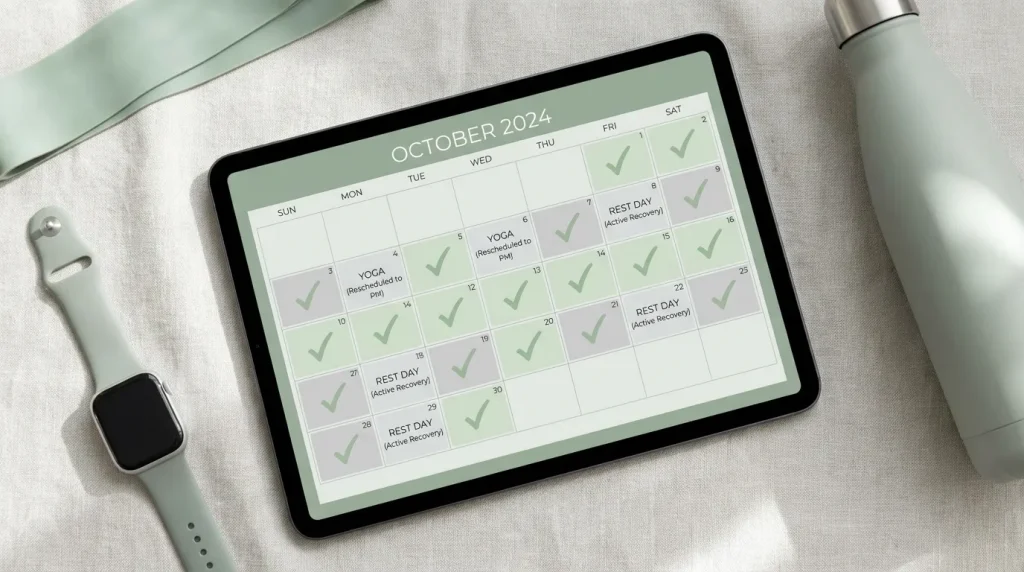
Within the FitSekai app, there is no penalty or structural breakdown when your schedule shifts. Our integrated calendar allows you to easily reschedule workouts to a different day with a simple tap.
Instead of seeing a red “failed” box on your screen, the app adapts to your actual life, preserving your visual consistency heatmap and keeping your streak alive. This flexibility removes the cognitive guilt of the “all-or-nothing” trap, ensuring your habit remains sustainable over the long term.
If you need a gentle, low-friction session to ease your body back into movement after an unscheduled break, you can load Module #1 (FitStart Home). This beginner-friendly module features brief, standalone workouts—such as mobility flows and gentle cardio sessions—that you can mix and match using the app’s Routine Maker to build a non-intimidating reentry routine.
Final Thought: Progress Is Measured in Months, Not Days
A resilient fitness lifestyle is not built on a foundation of flawless execution. It is built on the willingness to resume your routine after an unscheduled disruption [4].
Missing a workout is not a failure; it is simply a rest day your body or your schedule required. Alleviate the mental pressure, respect your body’s recovery signals, and focus entirely on showing up for your next session.
📎 Read Next:
- How to Build a Workout Habit When You’ve Never Exercised
- The Ultimate Beginner’s Guide to Making Fitness a Lifestyle
- Why Your First Workout Doesn’t Have to Be Perfect
- The 12-Minute Rule: Why Short Workouts Count (A Lot)
References & Further Reading
- Marlatt, G. A., & Gordon, J. R. (1985). Relapse Prevention: Maintenance Strategies in the Treatment of Addictive Behaviors. Guilford Press. (The foundational text introducing the Abstinence Violation Effect and cognitive habit loops) [1].
- American College of Sports Medicine. (2024). ACSM’s Guidelines for Exercise Testing and Prescription (11th ed.). Wolters Kluwer. (Standard physiological guidelines for detraining timelines and cardiorespiratory adaptations) [2].
- National Strength and Conditioning Association. (2024). Essentials of Strength Training and Conditioning (5th ed.). Human Kinetics. (The impact of systemic stress, cortisol, and planned recovery on muscle remodeling) [3].
- Clear, J. (2018). Atomic Habits: An Easy & Proven Way to Build Good Habits & Break Bad Ones. Avery. (Strategies for behavioral consistency, the ‘never miss twice’ rule, and environmental triggers) [4].
- Schoenfeld, B. J. (2023). Science and Development of Muscle Hypertrophy (2nd ed.). Human Kinetics. (The biology of muscular adaptations, atrophy timelines, and mechanical tension retention) [5].
ID: 26022
Category: Beginner Fitness
Content Type: Mindset / Consistency Guide
Search Intent: Informational
Word Count: ~1,510 words
Reading Time: ~7 minutes
IMPORTANT LEGAL & CREATIVE DISCLAIMERS
Artificial Intelligence & Generation Disclosure
Please be advised that the written text, formatting structures, hierarchical organization, and creative image generation prompts contained in this guide were researched, structured, and produced with the assistance of advanced artificial intelligence technologies. While the raw narrative generation was AI-aided, all historical references, anatomical mechanisms, and scientific studies (such as the peer-reviewed clinical data from the Journal of Strength and Conditioning Research and Sports Medicine) have been manually reviewed, cross-referenced, and verified for complete factual accuracy. All visual representations, graphic plans, and layout options are conceptual and have been generated with the assistance of artificial intelligence tools.
Health & Physical Activity Advisory
The information and educational materials provided in this guide are intended solely for general informational and learning purposes and do not constitute professional medical advice, clinical physiological diagnosis, or direct medical treatment. Engaging in any physical exercise program, particularly when utilizing modified home furniture or budget equipment, carries inherent risks of physical injury. It is strongly recommended that you consult with a qualified physician or certified healthcare professional before beginning any new training program, especially if you have pre-existing cardiovascular, metabolic, or musculoskeletal conditions. Stop exercising immediately if you experience pain, dizziness, or chest tightness.