
You have been consistent. You are showing up for your workouts, making more nutritious food choices, and feeling an unmistakable shift in your daily energy. Yet, when you step on the scale, the blinking digital numbers refuse to move. Sometimes, they even creep upward.
It is easy for panic to set in. You might ask yourself: Am I doing something wrong? Is my program a waste of time?
Exercise physiology offers a reassuring answer: the scale is often one of the least sensitive tools for measuring immediate physiological progress, especially when you are just beginning or returning to a structured training routine.
Your body weight is a dynamic, highly fluctuating variable. It is influenced by hydration levels, sodium intake, hormonal shifts, and glycogen storage. Meanwhile, profound, positive changes—such as increased lean muscle mass, fat reduction, improved metabolic rate, and functional capacity—occur quietly beneath the surface.
This guide provides practical, evidence-based methods to track progress without scale weight, helping you shift focus toward metrics that reflect your actual physical transformations.
Why the Scale Stalls (The Science of Body Recomposition)
To free yourself from the scale’s daily influence, it is helpful to understand the primary physiological processes that mask your progress:
1. Simultaneous Fat Loss & Muscle Gain (Body Recomposition)
Many people believe that fat loss and muscle gain must happen in separate, strict phases. However, a comprehensive scientific review by Barakat et al. (2020) published in the Strength & Conditioning Journal confirms that body recomposition—building muscle while losing fat simultaneously—is a well-documented phenomenon [1]. This is particularly pronounced in beginners, individuals returning to training, and those with higher starting body fat percentages.
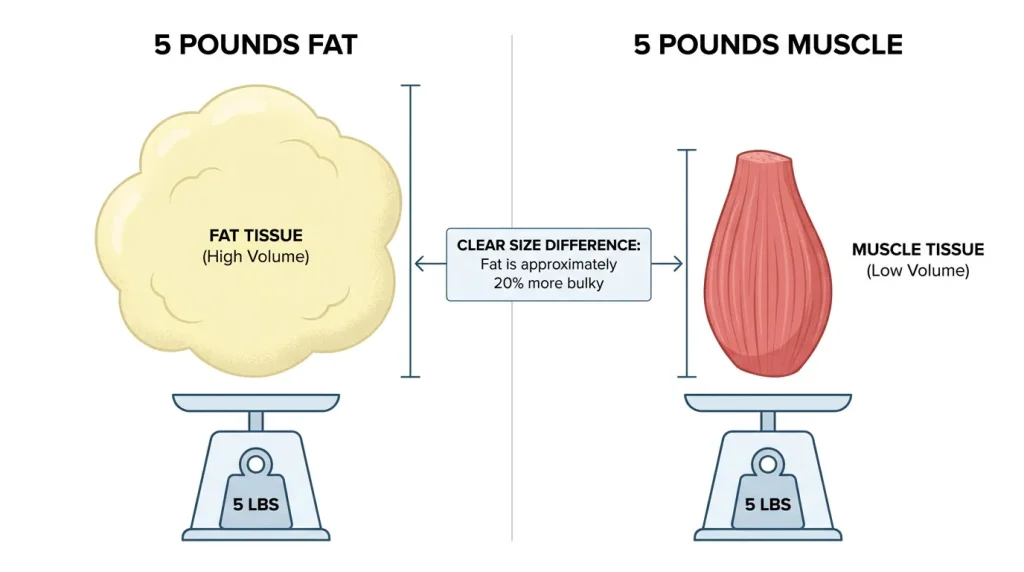
Because muscle tissue is denser than adipose tissue (fat), it occupies roughly 18% less volume per pound [2]. If you lose two pounds of fat and gain two pounds of muscle, your scale weight remains identical, but your waistline will shrink, and your body shape will change.
2. Muscle Inflammation and Water Retention
When you challenge your muscles with a new training stimulus—especially resistance training—you create micro-tears in the muscle fibers. This damage triggers a natural, localized inflammatory response. To facilitate healing, your body temporarily retains fluid around these muscle fibers. This transient water weight can easily cause a temporary 1-to-3-pound weight gain that has nothing to do with fat accumulation.
3. Increased Blood Volume and Glycogen Storage
If you have recently added cardiovascular exercise or high-intensity interval training (HIIT) to your routine, your body undergoes rapid blood volume adaptations [3]. Within the first one to two weeks, plasma volume can increase to support better oxygen delivery to working muscles.
Additionally, your muscles begin storing more glycogen (the storage form of carbohydrates) to fuel your workouts. Every single gram of glycogen stored in skeletal muscle binds with roughly 3 to 4 grams of water. This necessary metabolic adaptation can show up on the scale as a few extra pounds of water weight, even as you are actively burning fat.m of carbohydrates) to fuel your workouts. Every single gram of glycogen stored in skeletal muscle binds with roughly 3 to 4 grams of water. This necessary metabolic adaptation can show up on the scale as a few extra pounds of water weight, even as you are actively burning fat.
Better Ways to Track Progress (That Actually Matter)
If you want to maintain long-term consistency, you must look at your fitness progress tracking holistically. Here are the most reliable, objective metrics to measure your success:
Metric #1: Progressive Strength Gains
Strength is a direct indicator of neuromuscular adaptation. Long before your muscles visually change shape, your central nervous system becomes more efficient at recruiting muscle fibers to perform work [3].
What to monitor:
- The load: Can you lift a slightly heavier household object, dumbbell, or band than you did three weeks ago?
- The volume: Can you perform 12 repetitions of an exercise that used to exhaust you at 8 repetitions?
- The quality: Are your push-ups cleaner, deeper, and more controlled?
How to track it easily:
If you are training on your own, keeping a manual paper logbook is an excellent, self-guided way to track your strength progress. However, if you are a FitSekai user, you can bypass manual calculations entirely.
In the FitSekai app, we built a dedicated fitness tracker that lets you log your 1-Rep Max (1RM), Max Reps, and Max Hold Times (like planks or wall sits). Instead of guessing, you can see your performance metrics climb week-over-week, providing objective proof that your muscles are growing stronger, even if the scale is stationary.
Metric #2: Strategic Body Measurements
Because fat takes up more physical space than muscle, circumference measurements are a highly sensitive tool for monitoring fat loss, especially when body weight is stable.
What to measure (every 2 to 4 weeks):
- Waist: At the narrowest point or directly across your belly button.
- Hips: Around the widest part of your glutes.
- Thighs: At the midpoint of your upper leg.
- Arms: At the midpoint of your bicep (measured relaxed or flexed, just keep it consistent).
Pro-Tip: Focus on your waist-to-hip ratio. A shrinking waistline paired with static or slightly wider shoulder/hip measurements is the classic physiological signature of successful body recomposition.
Metric #3: Consistent Progress Photos
Your eyes can play tricks on you. Because you see yourself in the mirror multiple times a day, you are unlikely to notice the tiny, daily structural shifts in your physique. Monthly progress photos provide an objective, visual archive.
How to do it correctly:
- Timing: Take them once a month, first thing in the morning, before eating.
- Environment: Stand in the same spot, under the same lighting, wearing the same clothing.
- Angles: Take three clear, relaxed shots: one facing the camera, one profile (side view), and one back view.
Compare your “Month 1” photos directly to your “Month 3” photos. You will often see a visible change in muscle definition, posture, and body width that the scale completely failed to register.
Metric #4: Workout Recovery and Stamina
Your cardiovascular system and mitochondria (the energy factories in your cells) adapt rapidly to physical activity [3]. Improving your “cardiovascular conditioning” is a powerful indicator of metabolic health.
What to watch for:
- Do you stop gasping for air as quickly after a challenging set?
- Can you walk up three flights of stairs without feeling your chest heave?
- Is your resting heart rate trending down over time?
Metric #5: Subjective “Non-Scale Victories” (NSVs)
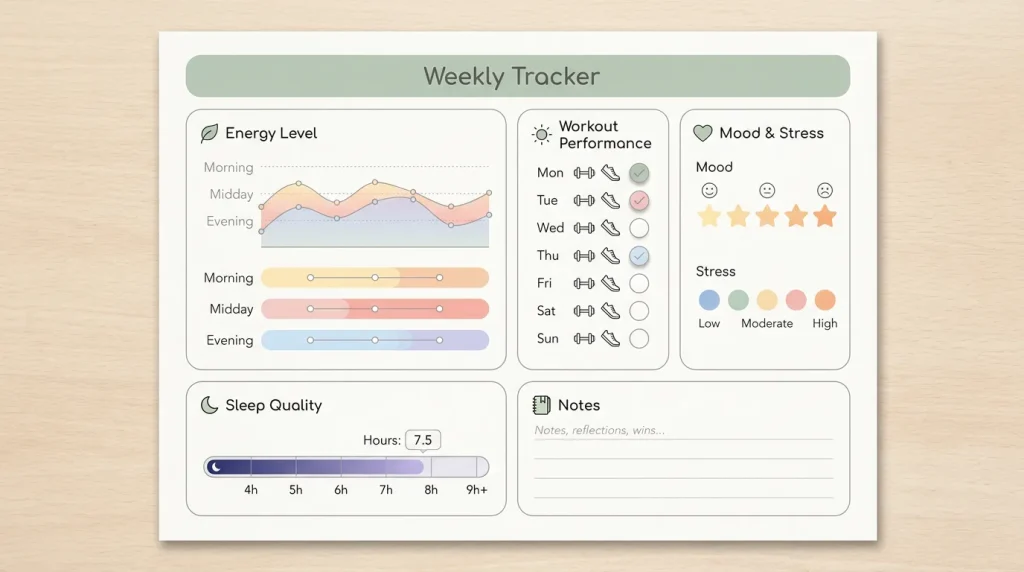
Not all progress can be written down as a number. Your daily quality of life is the ultimate validator of your routine. Pay close attention to these vital signs:
- Sleep Quality: Are you falling asleep faster and waking up feeling more restored? Exercise plays a recognized role in balancing deep sleep cycles.
- Daily Energy: Do you still experience a severe mid-afternoon energy crash, or is your stamina sustained throughout the day?
- Mood & Focus: Do you feel a reduction in daily anxiety and an increase in mental clarity after a workout?
- How Your Clothes Fit: Are your waistbands loosening? Do your shirts sit more comfortably across your shoulders? This is often the first place fat loss makes its presence known.
The “Too Easy / Just Right / Too Hard” Feedback Loop
Rather than stressing over numbers, successful, long-term exercisers rely on self-regulation. After completing a workout, ask yourself: How did that feel overall?
- Too Easy: You felt like you could have easily done another full round or doubled the reps.
- Just Right: The session was physically challenging and required focus, but you finished with good form and feel energized rather than depleted.
- Too Hard: You struggled to finish, your technique fell apart, or you feel exhausted and joint-sore for days afterward.
Manually adjusting your workout plan based on this feedback can be difficult for beginners. If you choose to track manually, you will need to constantly estimate your reps, hold times, and rest periods yourself. This is why we built our core training engine at FitSekai.
Instead of presenting you with static, unyielding video routines, FitSekai utilizes Smart Adaptive Training. At the end of every workout, you rate the session’s difficulty using our simplified Rate of Perceived Exertion (RPE) check-in. The app’s algorithm immediately processes your feedback, automatically scaling the reps, load, or duration of your next workout to match your exact rate of adaptation. It keeps you firmly in the “Just Right” zone, protecting you from plateaus and overtraining.
If You Choose to Weigh Yourself, Do It Smartly
If you still prefer to keep the scale as one of your data points, you must establish strict guidelines to protect your mental focus:
- Limit Frequency: Do not weigh yourself daily. Once a week or once every two weeks is more than enough to capture genuine body composition trends.
- Control the Variables: Always weigh yourself on the same day of the week, first thing in the morning, naked, and after using the bathroom.
- Look at the Curve, Not the Dot: Ignore individual weekly spikes. Look at a 3-month average trend line.
- Absolute Privacy: If seeing the scale numbers triggers stress, keep that data private. At FitSekai, your health data is 100% yours. The app stores all body weight and performance logs strictly on your local device with zero cloud data sharing. You can track your trends in absolute privacy, free from external monitoring or invasive ads.
Final Thought: Define Your Own Scoreboard
Your health and vitality are far too complex to be reduced to a single gravitational measurement on a plastic bathroom scale. The scale cannot measure the density of your bones, the strength of your heart, the resilience of your joints, or the consistency of your habits.
Shift your attention to how you move, how you sleep, how you feel, and how your strength is growing. When you start tracking the metrics that reflect actual health, you will find that consistency becomes natural—and the results will show, inside and out.
📎 Read Next:
- How to Build a Workout Habit When You’ve Never Exercised
- What Actually Happens to Your Body in the First 30 Days of Exercise
- The Complete Guide to Effective Home Workouts
- Strength Training 101: A Complete Beginner’s Guide
References & Further Reading
- Barakat, C., Pearson, J., Escalante, G., et al. (2020). Body Recomposition: Can Trained Individuals Build Muscle and Lose Fat at the Same Time? Strength & Conditioning Journal, 42(5), 7-21. (A definitive review of simultaneous muscle gain and fat loss) [1].
- Schoenfeld, B. J. (2023). Science and Development of Muscle Hypertrophy (2nd ed.). Human Kinetics. (Evidence-based principles of muscle tissue adaptation and load progression) [2].
- American College of Sports Medicine. (2026). ACSM’s Guidelines for Exercise Testing and Prescription. Wolters Kluwer. (ACSM updates on the health benefits of resistance and cardiorespiratory training) [3].
- Sato, S., Yoshida, R., Ryopo, R., et al. (2022). Effect of daily 3-s maximum voluntary isometric, concentric or eccentric contraction on elbow flexor strength. Scandinavian Journal of Medicine & Science in Sports, 32(5), 833-843. (Study demonstrating rapid strength adaptations without requiring massive resistance) [4].
ID: 26005
Category: Beginner Fitness
Content Type: Practical Guide
Intent: Informational
Word Count: ~1,510 words
Reading Time: ~7 minutes
IMPORTANT LEGAL & CREATIVE DISCLAIMERS
Artificial Intelligence & Generation Disclosure
Please be advised that the written text, formatting structures, hierarchical organization, and creative image generation prompts contained in this guide were researched, structured, and produced with the assistance of advanced artificial intelligence technologies. While the raw narrative generation was AI-aided, all historical references, anatomical mechanisms, and scientific studies (such as the peer-reviewed clinical data from the Journal of Strength and Conditioning Research and Sports Medicine) have been manually reviewed, cross-referenced, and verified for complete factual accuracy. All visual representations, graphic plans, and layout options are conceptual and have been generated with the assistance of artificial intelligence tools.
Health & Physical Activity Advisory
The information and educational materials provided in this guide are intended solely for general informational and learning purposes and do not constitute professional medical advice, clinical physiological diagnosis, or direct medical treatment. Engaging in any physical exercise program, particularly when utilizing modified home furniture or budget equipment, carries inherent risks of physical injury. It is strongly recommended that you consult with a qualified physician or certified healthcare professional before beginning any new training program, especially if you have pre-existing cardiovascular, metabolic, or musculoskeletal conditions. Stop exercising immediately if you experience pain, dizziness, or chest tightness.