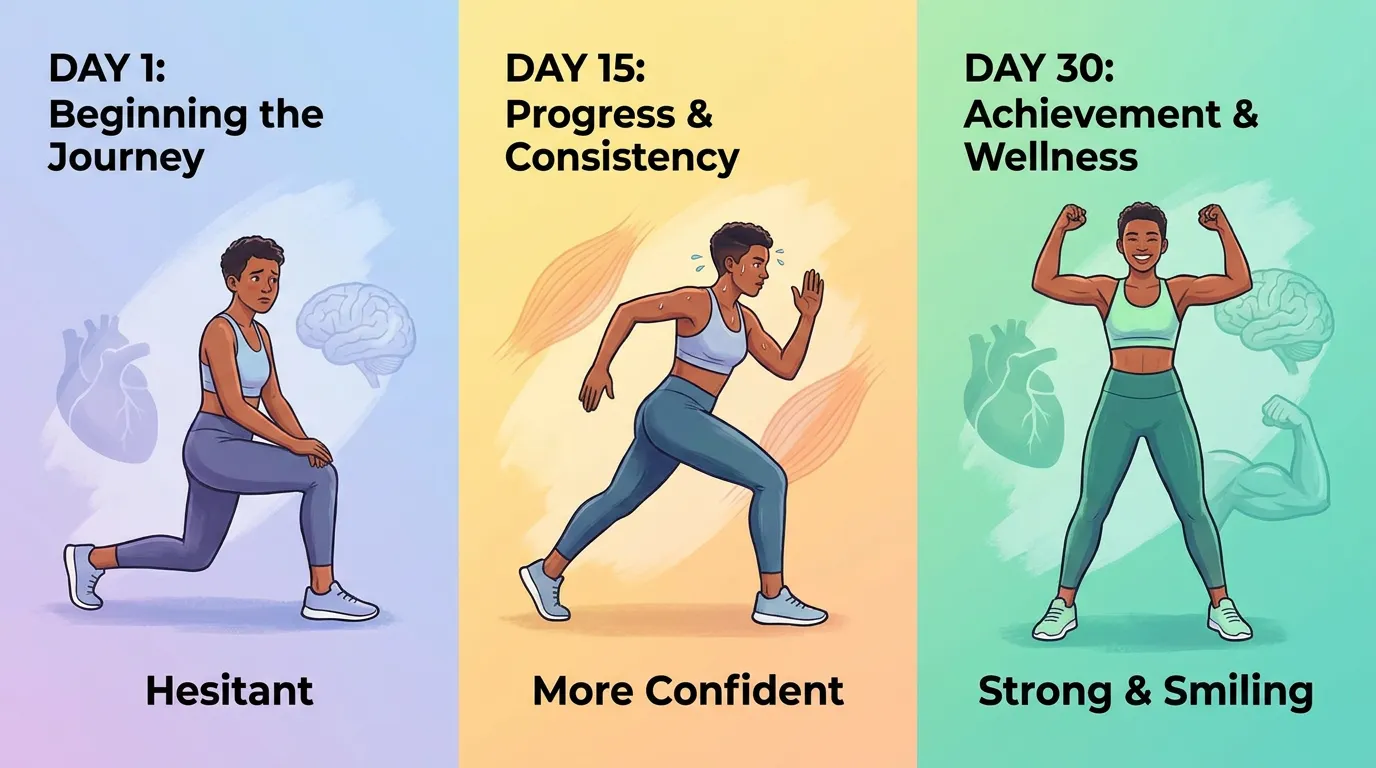
You’ve started exercising. You’re showing up. Now you’re wondering: When will I actually see results?
It’s a fair question. In a world of overnight transformations and 30-day challenges, it’s easy to expect dramatic physical changes fast. But the reality of what happens in your body during the first month of exercise is both more subtle—and more powerful—than most people realize.
This guide walks you through the science-backed timeline of physiological and psychological changes you can realistically expect in your first 30 days of consistent movement. No hype. No false promises. Just what actually happens—and how to recognize progress when it’s happening beneath the surface.
Week 1: Your Brain Is Changing Faster Than Your Body
Days 1-7: Neurological Adaptations Take the Lead
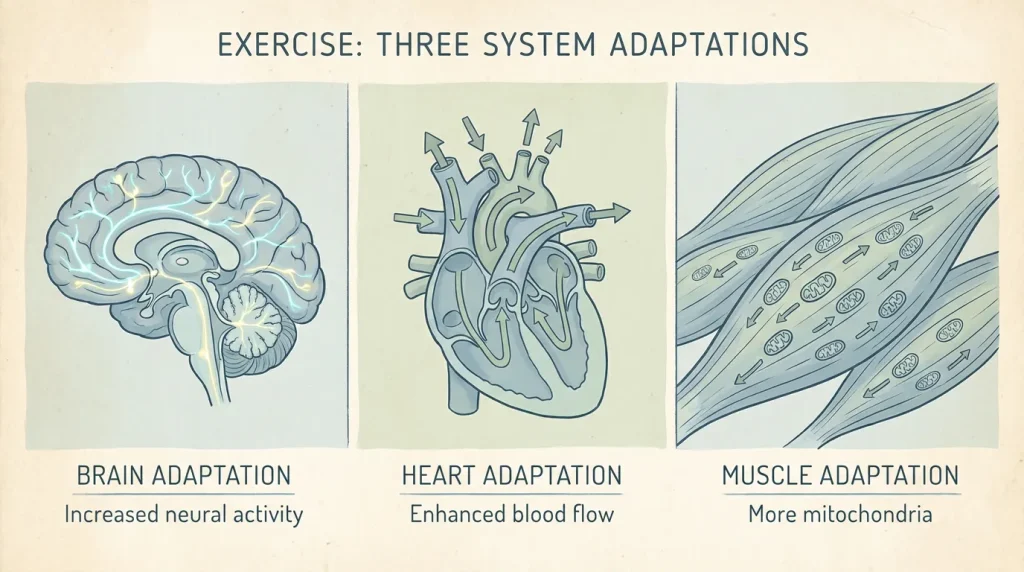
Here’s the surprising truth: In your first week of exercise, your muscles aren’t getting physically larger. Your brain is getting smarter.
When you start a new movement pattern—like a squat, push-up, or even a brisk walk—your nervous system is learning how to recruit muscle fibers more efficiently. This is called neuromuscular adaptation, and it’s why you might feel stronger after just a few sessions, even though your muscles haven’t visibly changed in size.
“The earliest gains in strength are almost entirely neurological. Your brain is learning to turn on the right muscles at the right time.” — Brad Schoenfeld, PhD, Leading Hypertrophy Researcher [1]
What you might notice:
- Movements feel slightly smoother or more coordinated.
- You’re less winded doing the same physical activity.
- You feel a subtle, post-workout mood boost (thanks to endorphins and other neurochemicals).
What you won’t notice yet:
- Visible muscle definition.
- Significant weight loss.
- Major leaps in absolute endurance.
This is completely normal. Exercise science confirms that neural adaptations account for almost all of your early strength gains. Your body is laying the foundation before building the house.
Week 2: Cardiovascular and Metabolic Shifts Begin
Days 8-14: Your Heart and Lungs Start Adapting
By the second week of consistent training, your cardiovascular system begins responding to the new demands.
Key physiological changes:
- Resting Heart Rate: Your resting heart rate may drop slightly (even 2-3 beats per minute is a win).
- Blood Volume: Your blood volume increases, improving oxygen delivery to your working muscles.
- Mitochondrial Density: The active energy powerhouses in your cells (mitochondria) begin to multiply.
- Insulin Sensitivity: Your insulin sensitivity improves, helping your body use blood glucose more efficiently.
Research from the American College of Sports Medicine (ACSM) indicates that even a few weeks of regular, moderate exercise can improve vascular function and support healthier blood pressure patterns in previously sedentary adults [2].
What you might notice:
- Climbing stairs feels noticeably easier.
- You recover faster between sets or intervals.
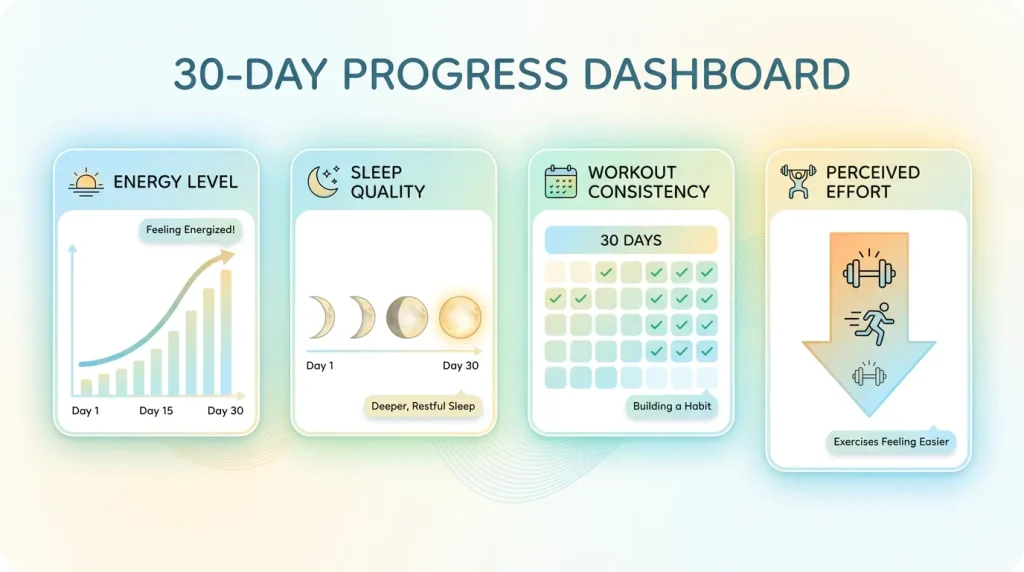
- You have slightly more energy during the middle of the day.
“The cardiovascular system is remarkably responsive. Even small doses of consistent movement trigger meaningful adaptations within days.” — Dr. Michael Joyner, Exercise Physiology Researcher [3]
The Mood Boost Is Real (And Science-Backed)
Around days 10-14, many beginners report a noticeable shift in mental state. This isn’t a placebo effect—it’s biochemistry.
Research in health psychology and neuroscience has consistently found that regular physical activity is associated with reduced symptoms of mild anxiety and stress, with mental benefits emerging within the first two weeks of consistent exercise.
Why it happens:
- Increased blood flow and oxygen delivery to the brain.
- Release of Brain-Derived Neurotrophic Factor (BDNF), which supports neuron health.
- Better regulation of stress hormones like cortisol.
Week 3: Muscular and Hormonal Responses Kick In
Days 15-21: Muscle Protein Synthesis Ramps Up
Around the three-week mark, your muscles begin the early stages of structural adaptation.
What’s happening:
- Protein Synthesis: Muscle protein synthesis increases after each workout, especially with resistance training, laying the groundwork for future muscle tone [1].
- Connective Tissue: Your tendons and ligaments strengthen, supporting your joints and reducing injury risk [2].
- Hormonal Response: Your body optimizes its hormonal response, triggering acute increases in growth-related hormones that support tissue repair.
What you might notice:
- Your muscles feel “fuller” or more engaged during movement.
- Post-workout muscle soreness (DOMS) decreases as your body adapts.
- You can perform slightly more repetitions or hold positions longer.
Sleep Quality Often Improves
By week 3, many beginners report falling asleep faster and sleeping more deeply.
The National Sleep Foundation and sleep research indicate that regular moderate exercise can support healthier sleep patterns, including faster sleep onset and improved sleep quality [4]. The mechanism? Exercise helps regulate your body’s circadian rhythms and reduces physiological arousal that interferes with sleep onset.
Week 4: Integration and Early Performance Gains
Days 22-30: The Pieces Start Connecting
By the end of your first month, multiple physiological systems are working together more efficiently.
Integrated adaptations:
- Synergy: Neuromuscular coordination + cardiovascular efficiency + metabolic flexibility = noticeably easier movement.
- Self-Efficacy: You’ve proven to yourself you can show up consistently, which builds self-belief.
- Habit Consolidation: The behavior is becoming more automatic, requiring less conscious effort to start [6].
Research in exercise science shows that beginners who complete several weeks of consistent training often report improvements in submaximal exercise capacity, muscular endurance, and subjective energy levels.
What you might notice:
- Workouts that felt challenging in Week 1 now feel completely manageable.
- Daily activities (carrying groceries, walking stairs, carrying children) feel easier.
- You look forward to daily movement instead of dreading it.
“The first month is about building the bridge between intention and identity. You’re not just exercising—you’re becoming someone who exercises.” — Dr. Wendy Wood, Habit Research Expert [6]
What You Won’t See Yet (And Why That’s Okay)
Let’s manage expectations honestly:
- ❌ Visible muscle definition: Hypertrophy takes weeks to months of progressive overload to become visually apparent [1].
- ❌ Significant fat loss: Sustainable changes take time; your scale weight may fluctuate or stay the same in 30 days.
- ❌ Dramatic endurance leaps: Cardiovascular improvements are measurable but subtle early on.
- ❌ “Transformation” photos: Real physical change is gradual; social media highlights are not the baseline norm.
This isn’t discouraging—it’s freeing. When you know what to expect, you can celebrate the right wins.
How to Track Progress When the Scale Won’t Budge
The tracking methods outlined below are an independent, highly effective manual layout you can follow if you choose to train on your own.
App Integration Tip: If you are a FitSekai user, there is no need to manually coordinate exercises, track times, or write down rep schemes. We recommend launching Module #1: FitStart Home (Tagline: Start strong. Stay home. Feel better.).
This beginner-friendly, equipment-light module features 10 standalone workouts, such as FitStart Home Warmup (wo_id 1), FitStart Home Fullbody (wo_id 2), and FitStart Home Cooldown (wo_id 10). Using the app’s intuitive Routine Maker, you can easily mix, match, and organize these workouts into your own custom weekly schedule.
1. Performance Log
Keeping a manual notebook of your lifts is a highly effective way to track progress without an app. Note one small win after each workout:
- “Did 2 more squats than last time”
- “Held my plank 5 seconds longer”
FitSekai tracking tip: The app features an integrated fitness tracker that allows you to easily log your body weight, 1-Rep Max (1RM), Max Reps, and Max Hold Times (like planks or wall sits) directly on your dashboard.
2. The “Too Easy / Just Right / Too Hard” Scale
If you are training on your own, you can manually adjust your weights and reps based on this subjective scale.
FitSekai progression tip: For FitSekai users, this process is completely automated. After every workout, you rate the difficulty, and our Smart Adaptive Training engine automatically scales your next session’s target reps, hold times, and tempos—ensuring you stay in the optimal adaptive zone.
Final Thought: Trust the Process, Not the Timeline
Your body is adapting right now—even if you can’t see it yet. The neurological wiring, the cardiovascular efficiency, the hormonal balance, and the mental resilience are the invisible foundations of visible change.
As Dr. John Ratey, Harvard psychiatrist, puts it:
“Exercise is not just about changing your body. It’s about changing your brain—and that change starts immediately.” [5]
So keep showing up. Celebrate the subtle wins. Trust that consistency compounds. Day 30 isn’t the finish line. It’s the proof that you can begin.e proof that you can begin.
📎 Read Next:
- The Ultimate Beginner’s Guide to Making Fitness a Lifestyle
- How to Build a Workout Habit When You’ve Never Exercised
- Strength Training 101: A Complete Beginner’s Guide
- How to Track Progress When the Scale Won’t Budge
References & Further Reading
- Schoenfeld, B. J. (2020). Science and Development of Muscle Hypertrophy (2nd ed.). Human Kinetics. (Evidence-based resource on muscle adaptation principles) [1].
- American College of Sports Medicine. (2021). ACSM’s Guidelines for Exercise Testing and Prescription (11th ed.). Wolters Kluwer. (Authoritative source for exercise recommendations and physiological adaptations) [2].
- Joyner, M. J., & Casey, D. P. (2015). Regulation of increased blood flow during exercise: A balance of vasodilation and vasoconstriction. Journal of Applied Physiology, 130(3), 639-651. (Research on cardiovascular adaptations to exercise) [3].
- National Sleep Foundation. (2023). Sleep Duration Recommendations and Exercise. Retrieved from sleepfoundation.org. (Consensus guidelines on sleep and physical activity) [4].
- Ratey, J. J., & Loehr, J. E. (2008). Spark: The Revolutionary New Science of Exercise and the Brain (Updated ed.). Little, Brown Spark. (Research on exercise and mental health) [5].
- Wood, W., & Rünger, D. (2016). Psychology of Habit. Annual Review of Psychology, 67, 289-314. (Comprehensive review of habit formation science) [6].
- Centers for Disease Control and Prevention. (2023). Physical Activity Basics. Retrieved from cdc.gov/physicalactivity. (Authoritative source for activity guidelines and health benefits) [7].
ID: 26003
Category: Beginner Fitness
Content Type: Physiology Guide / Expectation Setting
Intent: Informational
Word Count: ~1,490 words
Reading Time: ~7 minutess
IMPORTANT LEGAL & CREATIVE DISCLAIMERS
Artificial Intelligence & Generation Disclosure
Please be advised that the written text, formatting structures, hierarchical organization, and creative image generation prompts contained in this guide were researched, structured, and produced with the assistance of advanced artificial intelligence technologies. While the raw narrative generation was AI-aided, all historical references, anatomical mechanisms, and scientific studies (such as the peer-reviewed clinical data from the National Strength and Conditioning Association and Human Kinetics) have been manually reviewed, cross-referenced, and verified for complete factual accuracy. All visual representations, graphic plans, and layout options are conceptual and have been generated with the assistance of artificial intelligence tools.
Health & Physical Activity Advisory
The information and educational materials provided in this guide are intended solely for general informational and learning purposes and do not constitute professional medical advice, clinical physiological diagnosis, or direct medical treatment. Engaging in any physical exercise program, particularly when utilizing modified home furniture or budget equipment, carries inherent risks of physical injury. It is strongly recommended that you consult with a qualified physician or certified healthcare professional before beginning any new training program, especially if you have pre-existing cardiovascular, metabolic, or musculoskeletal conditions. Stop exercising immediately if you experience pain, dizziness, or chest tightness.