Build Strength in the Evening: Your Post-Work Full-Body Routine.
Many beginners believe that building strength requires heavy barbells, specialized lifting platforms, and hours inside a commercial gym. They assume that if they cannot load several weight plates onto a bar, they cannot make progress.
But here is what biomechanics confirms: your body only understands mechanical tension.
Whether that tension is generated by pushing against a heavy barbell or resisting gravity through progressive bodyweight leverage, your muscle fibers undergo the exact same structural adaptations [1]. By selecting home exercises that maximize time under tension and pelvic stability, you can build real-world, functional strength entirely from your living room.
This guide outlines the principles of home-based progressive overload and provides a safe, under-30-minute weeknight strength routine.
The Biomechanics of Home Strength Training
When training at home, especially with limited equipment, you must use alternative mechanical variables to apply progressive overload:
- Time Under Tension (TUT): Slowing down your repetitions forces your muscles to spend more time actively resisting gravity, recruiting high-threshold motor units [1].
- Isometric Holds: Holding a challenging joint position (like a plank or glute bridge hold) forces your nervous system to fire muscle fibers at high frequency to maintain stability [3].
- Unilateral Loading: Moving from double-leg to single-leg variations (like split squats) doubles the relative load on your working limbs without requiring extra weights.
By focusing on these variables, you can stimulate muscle hypertrophy and build joint resilience safely, without the high axial spinal load of heavy barbells.
The Manual Evening Strength Routine
The program detailed below is an independent, highly effective manual layout you can follow if you choose to train on your own.
Manual alternative: If you are training independently, execute this 30-minute strength routine using your own weight selection and manual stopwatches.
Workout Structure: 3-Round Circuit
Perform each of the 5 movements below for 40 seconds, followed by 20 seconds of recovery. Rest for 60 seconds after completing all 5 movements, then repeat the circuit for a total of 3 rounds.
- Warm-Up (2 Minutes): Spend 2 minutes preparing your joints with slow arm circles, torso rotations, and dynamic bodyweight squats.
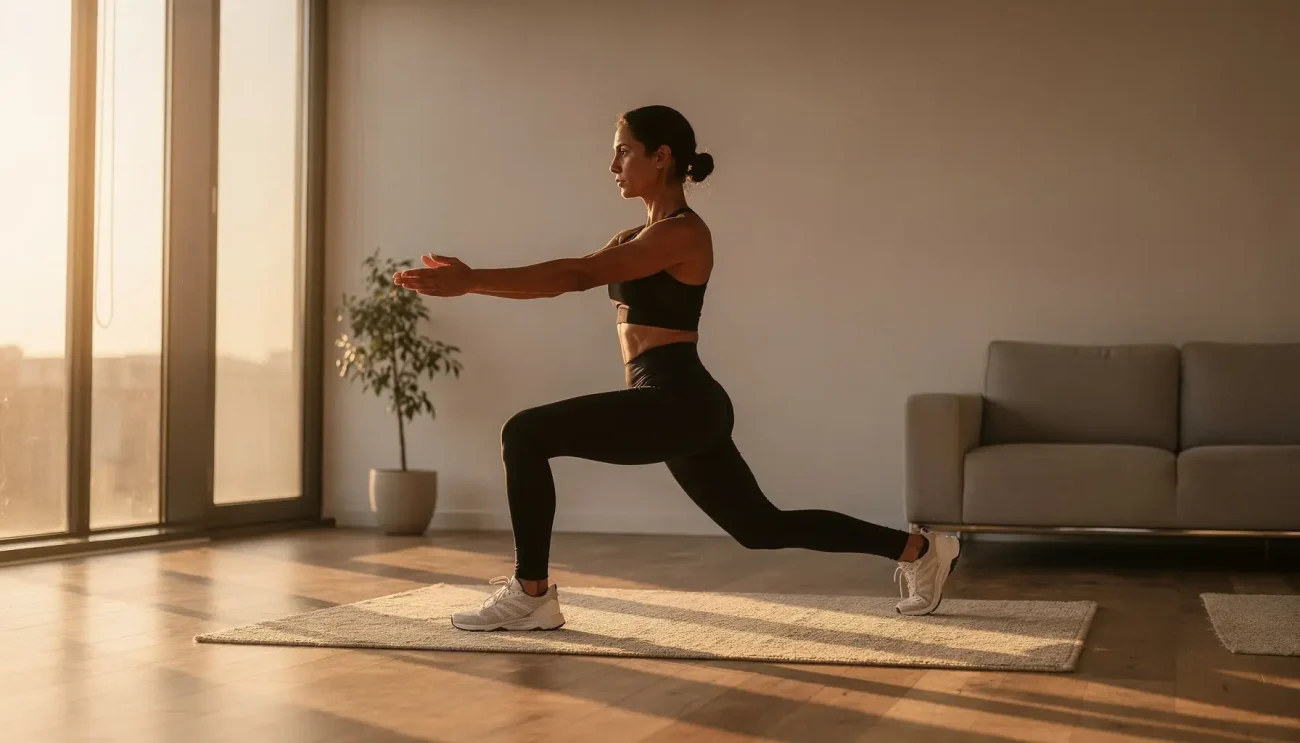
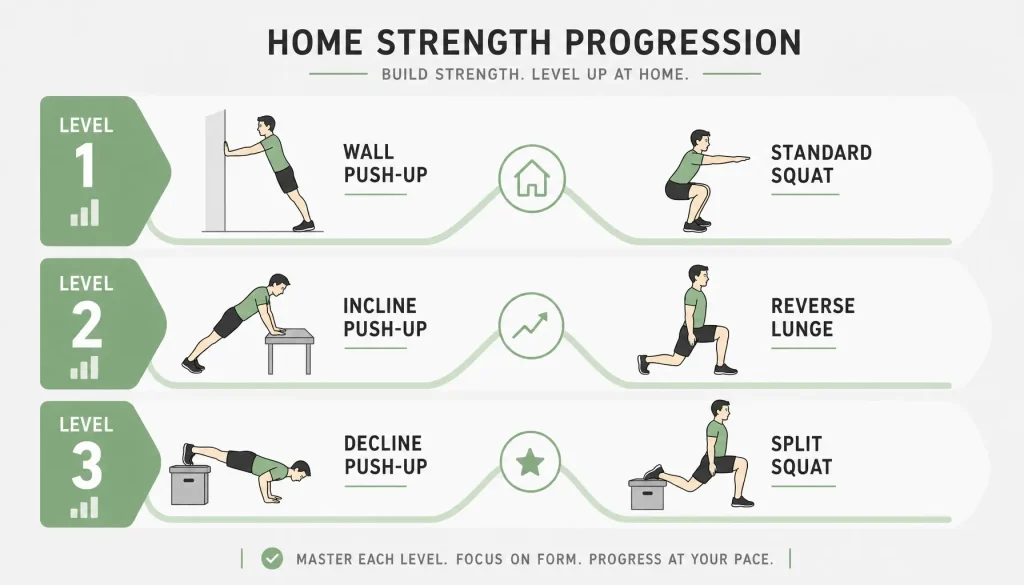
- Station 1 (Squat Pattern): Alternating Reverse Lunges (focusing on a slow, 3-second descent).
- Station 2 (Push Pattern): Incline Couch Push-Ups (hands placed on the arm of your couch).
- Station 3 (Hinge Pattern): Single-Leg Glute Bridges (actively squeezing your glutes at the top).
- Station 4 (Pull Pattern): Doorframe Rows (gripping the doorway frame, leaning back, and pulling forward).
- Station 5 (Core Pattern): Static Plank Hold (keeping your abdominals fully braced).
- Cooldown (1 Minute): Spend 1 minute performing standing hamstring stretching and slow, deep diaphragmatic breathing.
Build Unshakeable Strength with FitSekai
If you are a FitSekai user, there is no need to manually coordinate exercises, track times, or write down rep schemes. We recommend launching Module #6 (Weeknights’ Build).
This progressive, strength-focused module features two parallel tracks—No-Kit and Home Gym—designed specifically for evening training. Across three phases, it builds foundational strength, muscular endurance, and movement control using either bodyweight or accessible home equipment.
FitSekai’s Smart Adaptive Training engine automatically processes your post-workout feedback, scaling your reps, hold times, and tempos for your next session to ensure you stay in the optimal adaptive zone.
Final Thought: Master the Tension
Building real-world strength is not about the absolute number of plates you can hold; it is about your functional mastery over your own body mass [2]. Step onto your mat, open the FitSekai app, and take control of your repetitions.
📎 Read Next:
References & Further Reading
- Schoenfeld, B. J. (2023). Science and Development of Muscle Hypertrophy (2nd ed.). Human Kinetics. [1].
- American College of Sports Medicine. (2024). ACSM’s Guidelines for Exercise Testing and Prescription (11th ed.). Wolters Kluwer. [2].
- Lum, D., & Barbosa, T. M. (2019). Brief Review: Effects of Isometric Strength Training on Strength and Dynamic Performance. Strength & Conditioning Journal, 41(5), 7-21. [3].
ID: 26033
Title: Build Strength in the Evening: Your Post-Work Full-Body Routine
Description: Own your evenings. Learn how to build real-world strength and muscle at home using progressive bodyweight leverage or simple dumbbells before bed.Category: Home Workouts
Content Type: Deep Dives
Intent: Informational / Practical
Target Word Count: 1,000 words
Word Count: ~1,010 words
Reading Time: ~5 minutes
IMPORTANT LEGAL & CREATIVE DISCLAIMERS
Artificial Intelligence & Generation Disclosure
Please be advised that the written text, formatting structures, hierarchical organization, and creative image generation prompts contained in this guide were researched, structured, and produced with the assistance of advanced artificial intelligence technologies. While the raw narrative generation was AI-aided, all historical references, anatomical mechanisms, and scientific studies (such as the peer-reviewed clinical data from the Journal of Strength and Conditioning Research and Sports Medicine) have been manually reviewed, cross-referenced, and verified for complete factual accuracy. All visual representations, graphic plans, and layout options are conceptual and have been generated with the assistance of artificial intelligence tools.
Health & Physical Activity Advisory
The information and educational materials provided in this guide are intended solely for general informational and learning purposes and do not constitute professional medical advice, clinical physiological diagnosis, or direct medical treatment. Engaging in any physical exercise program, particularly when utilizing modified home furniture or budget equipment, carries inherent risks of physical injury. It is strongly recommended that you consult with a qualified physician or certified healthcare professional before beginning any new training program, especially if you have pre-existing cardiovascular, metabolic, or musculoskeletal conditions. Stop exercising immediately if you experience pain, dizziness, or chest tightness.