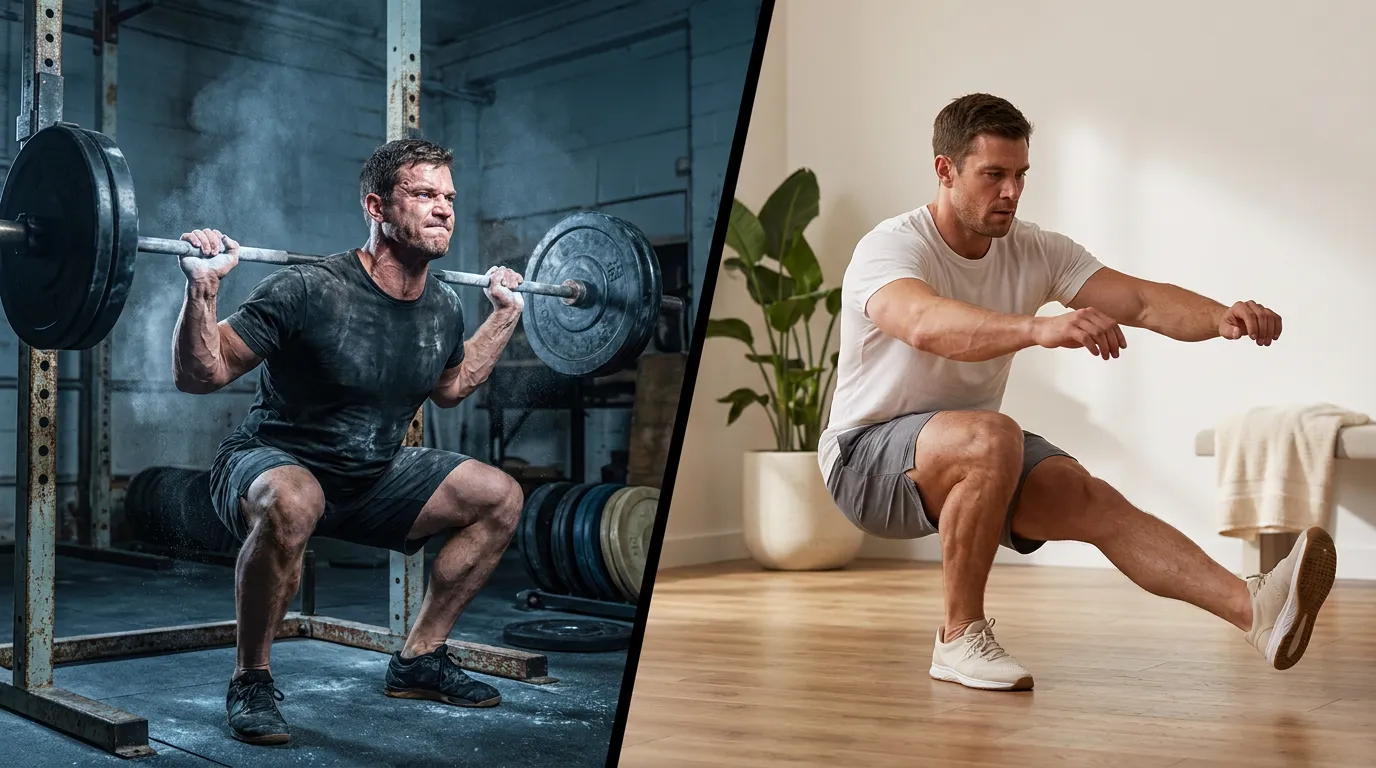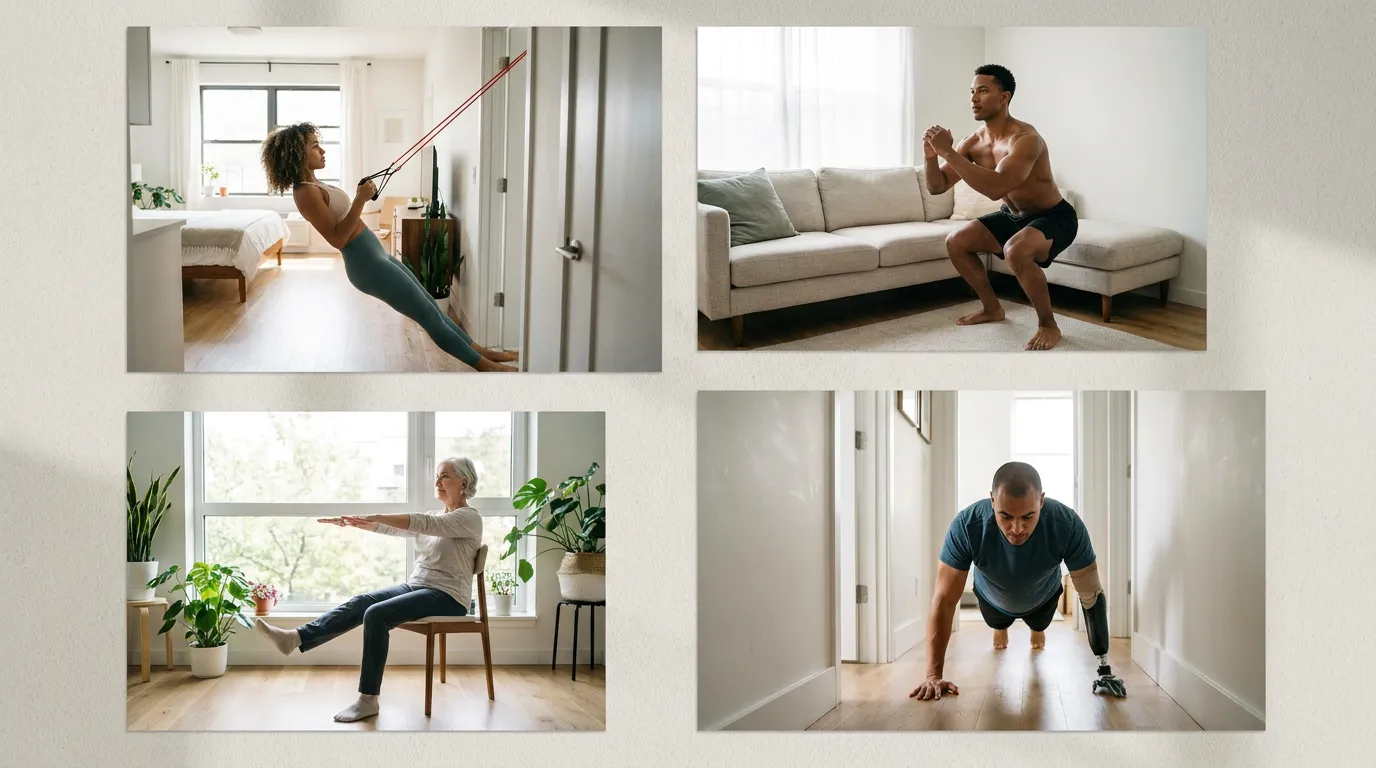
You have probably stood in the sporting goods aisle, staring at a rack of adjustable dumbbells priced like a used car, and thought: Maybe I will just stick to basic bodyweight moves.
Here is the truth the fitness industry rarely advertises: you do not need $500 of complex gear to get serious results. You need intentional equipment selection, smart sourcing, and a physical setup that actually gets used.
Industry observations suggest that beginners often spend more than necessary on their first equipment purchase—buying motorized devices that end up collecting dust rather than functional tools that build consistency. The most effective home setups are not the most expensive; they are simply the most accessible.
This guide provides a tactical blueprint for building a highly functional, progressive training space for less than the cost of a single monthly gym membership.
The Exact $100 Blueprint
When a budget is tight, every dollar must perform double duty. Here is how to allocate your funds to maximize movement variety and long-term progression:
| Item | Estimated Cost | Why It Earns Its Place |
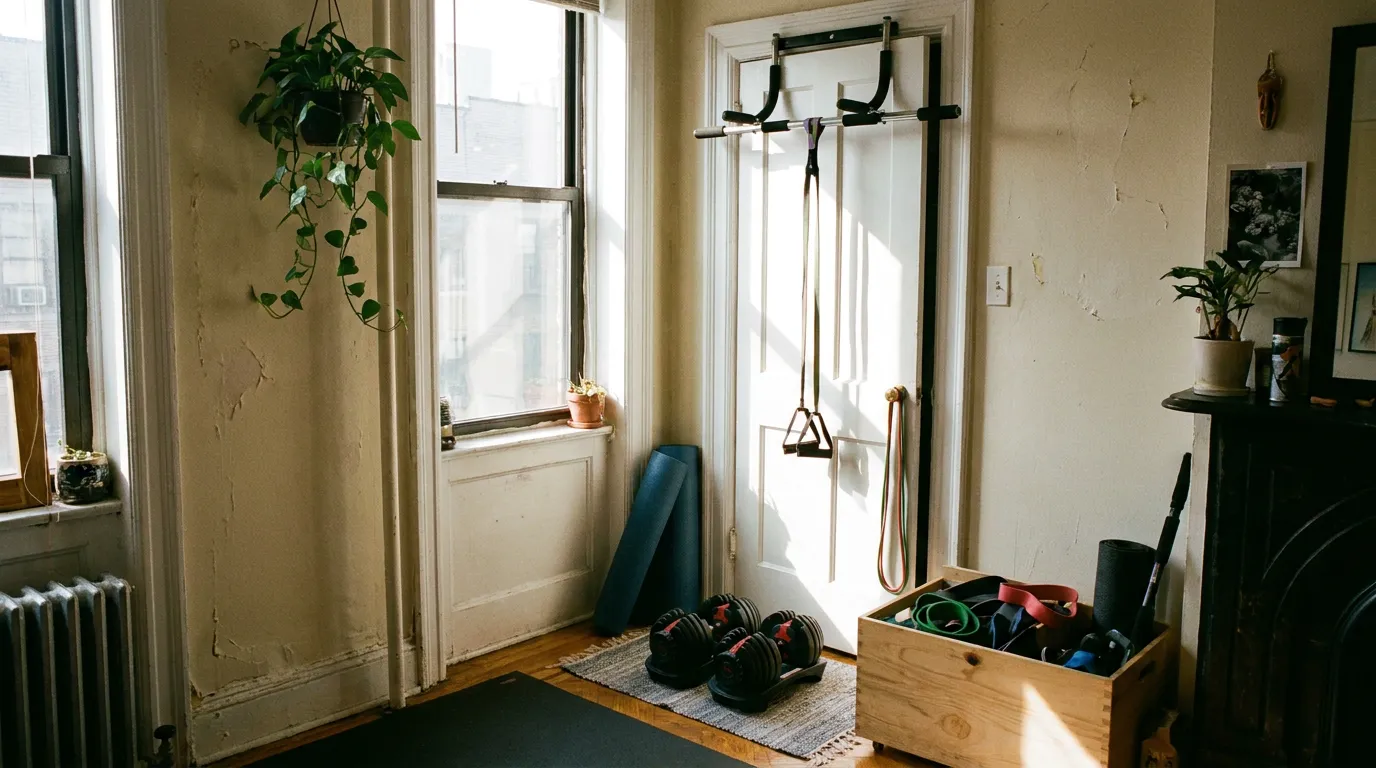
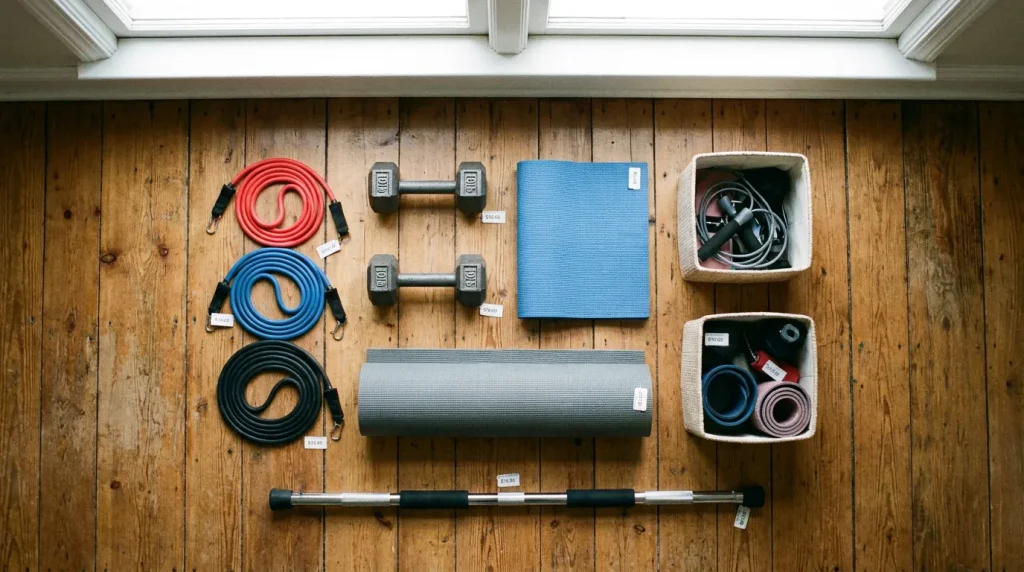
| Resistance Band Set (5 latex bands + door anchor) | $18-$25 | Replaces an entire rack of cables for pressing, pulling, and lower-body work. |
| Adjustable Dumbbells (or 2 fixed pairs, e.g., 10lb & 20lb) | $35-$45 | Adds direct external load for compound squats, lunges, rows, and overhead work. |
| High-Density Yoga/Exercise Mat | $20-$25 | Protects joints during floor movements and serves as a dedicated training zone. |
| Doorway Pull-Up Bar | $20-$30 | Unlocks vertical pulling (a movement pattern often neglected in no-equipment home routines). |
| Storage Bin / Wall Hooks | $5-$10 | Keeps your gear organized. Removing physical clutter directly reduces mental friction. |
Total: Approximately 98-135 (depending on local tax, sales, and specific brand choices).
The Science of Minimalist Training Gear
It is easy to assume that inexpensive equipment yields inferior physical results. However, sports science indicates otherwise [1].
A study published in the Journal of Strength and Conditioning Research by Colado et al. (2010) compared training with elastic bands to traditional gym weight machines [5]. The researchers found that when training intensity and volume were controlled, the group using resistance bands achieved identical improvements in body composition and muscular strength to the group using commercial gym machines.
The variable resistance curve of a latex band—which increases in tension as it stretches—actually matches your muscles’ natural strength curves, providing deep fiber recruitment at the peak of contraction.
Furthermore, a systematic review by Schoenfeld et al. (2017) demonstrated that as long as sets are performed near muscular fatigue (high effort), lighter loads can stimulate muscle hypertrophy similarly to heavy gym weights [1]. This confirms that a minimalist home gym consisting of adjustable dumbbells and resistance bands is fully capable of driving physical transformations.
“Equipment doesn’t create results. Frequency and progressive challenge do. A simple setup used consistently will outperform an elaborate gym visited sporadically.” — Menno Henselmans, Exercise Scientist and Evidence-Based Fitness Coach
Where & How to Buy (Without Wasting Money)
Acquiring your affordable fitness gear requires a strategic purchasing plan. Avoid the markup common to retail store shelves by following these practical rules:
1. Skip the Big-Box Markup
Specialty athletic retailers often add significant retail markups for brand names. Look for direct-to-consumer online brands, warehouse stores, or general discount retailers where steel dumbbells and latex bands are sold closer to manufacturing cost.
2. Leverage the Secondhand Market
Fitness equipment is notoriously subject to impulse buys. Platforms like Facebook Marketplace, OfferUp, and local estate sales are filled with pristine, barely used dumbbells and pull-up bars. Steel weights do not degrade with age. Buying a moderately priced pair of cast-iron dumbbells on the secondhand market is functionally identical to purchasing a brand-new set at retail price.
3. Under the Microscope: How to Inspect Used Gear
When purchasing secondhand equipment, take a few moments to verify safety and functionality:
- Latex Bands: Pull each band to its full functional length in a safe direction. Check for white stress marks, micro-cracks, or dry rot. A compromised band can snap under tension.
- Adjustable Dumbbells: Look for deep rust that compromises structural integrity (surface rust is harmless and can be cleaned with a wire brush). Check that screw-on collars thread smoothly and lock tightly.
- Doorway Pull-Up Bars: Verify that the foam pads are intact to protect your door trim, and check that the structural bolts are tight and unbent.
Setting Up for Consistency (The Psychology of Friction)
A home gym does not need to look like a high-end studio. It needs to remove physical friction.
Environmental psychology research confirms that visibility and ease of access directly drive habit formation [3]. In Atomic Habits, James Clear summarizes this behavioral feedback loop:
“We don’t rise to the level of our goals. We fall to the level of our systems. Make the right behavior the path of least resistance.” — James Clear, Author of Atomic Habits [4]
If you have to dig through a cluttered closet, drag furniture across the room, and unroll a tightly bound mat just to start your session, your brain will often choose comfort over effort.
The 3-Minute Rule for Budget Setup
- Locate your zone: Keep your storage bin directly next to your designated training space.
- Store bands neatly: Hang your resistance bands on simple wall hooks rather than tossing them into a tangled ball inside a drawer.
- Position the pull-up bar permanently: If safe and practical, leave your doorway pull-up bar mounted on a high-traffic frame. Seeing it daily acts as a silent physical cue to perform a set of dead-hangs or pull-ups.
If you reside in a studio apartment or shared flat, utilize a low-profile, under-bed storage container. The physical ritual of rolling out the container and placing your mat should take under 60 seconds.
Progressing Without Buying Heavier Weights
A common limitation of a budget home gym setup is the fear of stagnation. Once you can easily complete your repetitions with a 15-pound dumbbell, how do you keep growing without buying a 25-pound dumbbell?
You do not need more gear. You need better biomechanics.
Progression Strategies That Cost $0
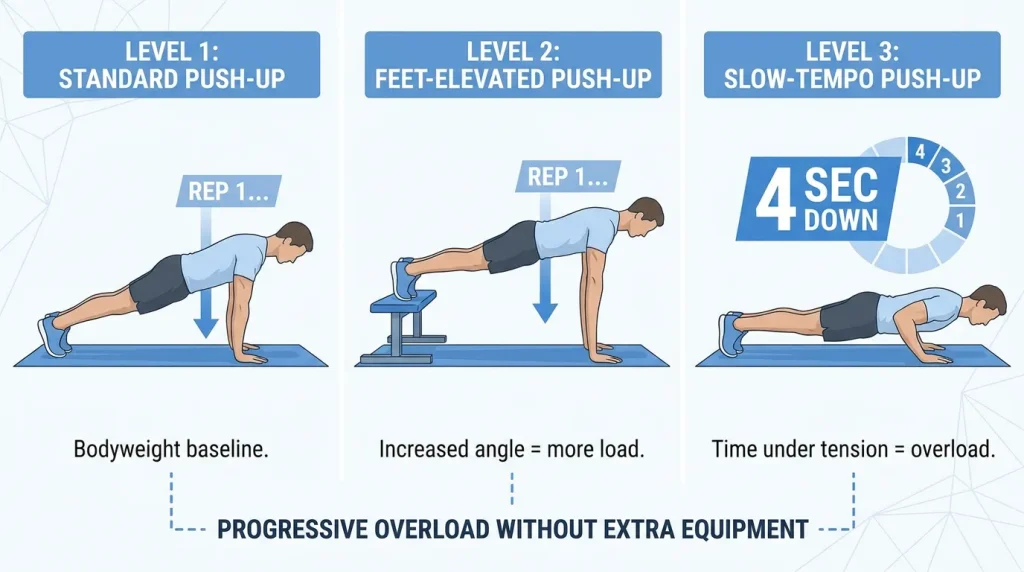
- Tempo Manipulation: Slow down the eccentric (lowering) phase of your movements to 3 to 4 seconds [5]. This increases the muscle’s time under tension and metabolic stress without requiring any added load.
- Leverage Changes: Alter your positioning. If standard floor push-ups become comfortable, place your hands on blocks or books to increase the range of motion, or elevate your feet on a chair (decline push-ups) to increase the relative load.
- Density Adjustments: Keep your weight and reps the same, but reduce your rest times between sets by 10 to 15 seconds. This forces your body to adapt to cardiorespiratory and metabolic demands.
Automating Your Progression with FitSekai
Instead of trying to manually calculate your tempos or guessing when to shorten rest periods, let technology handle the adjustment.
Inside the FitSekai app, we utilize Smart Adaptive Training to manage your rate of progress. When you finish a workout in any of our home-focused programs, you rate your physical effort on a simple post-workout scale. FitSekai’s engine immediately processes this feedback, dynamically scaling your upcoming sessions—automatically adjusting your target reps, holds, and tempos—to ensure you continue making progress without needing to buy heavier weights.
To support focus during your sessions, FitSekai’s Text-to-Speech (TTS) engine is built directly into your active workout play screen. It provides clear audio workout cues as you transition between exercises, along with option-based, manually activated audio descriptions of the exercises when you need a quick technical form reminder.
What to Skip (Protect Your Budget)
To stay strictly under a $100 limit, you must avoid the “fitness novelty” trap. Guard your wallet by skipping these unnecessary purchases:
- 🚫 “Toning” Gadgets & Ab Rollers: There is very little peer-reviewed evidence proving these isolated tools outperform basic compound movements like planks, squats, and push-ups.
- 🚫 Cheap Folding Cardio Machines: Motorized treadmills or stationary bikes priced under $200 often have poor build quality, break easily, and strain joints. Running or walking outdoors remains a free, highly effective cardiorespiratory alternative.
- 🚫 “Smart” Fitness Subscriptions: You do not need expensive screens or app-locked hardware to receive premium guidance. While high-end platforms demand expensive monthly commitments, a premium FitSekai subscription offers total adaptive personalization and over 1,800 routines for only
2.99/month∗∗or∗∗2.99/month∗∗or∗∗24.99/year. This gives you full, distraction-free access without breaking your budget.
Your First Week with the $100 Blueprint
Ready to begin? You can test your budget setup by leveraging Module #1: FitStart Home (Tagline: Start strong. Stay home. Feel better.) inside the FitSekai app.
FitStart Home is an equipment-light, beginner-friendly training module featuring 10 standalone workouts that build strength, mobility, cardio, and balance. FitSekai also includes a flexible Routine Maker, allowing you to mix, match, and create your own customized workout routine utilizing these 10 distinct sessions to fit your space and gear.
- Day 1 (The Unpacking): Lay out your mat, set up your storage container, and hang your bands. Mix and match a simple setup check routine in the Routine Maker using FitStart Home Warmup, FitStart Home Fullbody, and FitStart Home Cooldown to ensure your space feels functional.
- Day 2 (Recovery): Keep your gear visible. Do not tuck it away.
- Day 3 (The Adjustment): Run the same test circuit. If the movements felt “Too Easy” on Day 1, slow the lowering phase down to a 4-second count.
- Day 4 (Recovery): Hang your pull-up bar securely in your designated doorway.
- Day 5 (The Vertical Pull): Test the pull-up bar. Try loading up FitStart Home Upper Body to integrate your doorway bar. If a full pull-up is too difficult, practice controlled “dead hangs” to build grip strength or place a chair beneath the bar to perform assisted rows.
- Day 6 (Recovery): Build your cardiovascular base with FitStart Home Cardio or go for a brisk 20-minute jog outdoors.
- Day 7 (The Reflection): Ask yourself: Was my gear easily accessible? Did I waste time setting up? Adjust your storage and physical layout accordingly.
Final Thought: Access Over Assets
A home gym is not an investment in steel and rubber; it is an investment in daily physical access.
By establishing a cheap home workout equipment setup, you eliminate the time spent commuting, expensive recurring memberships, and the friction of crowded weight racks. You trade convenience for consistency.
Set up your space simply, spend your budget wisely, and let your consistency do the heavy lifting.
📎 Read Next:
- Bodyweight Training: Is It Enough to Build Real Strength?
- Small Space, Big Results: Apartment-Friendly Workouts
- Dumbbell Training: The Most Versatile Tool for Home Gyms
- The Complete Guide to Effective Home Workouts
References & Further Reading
- Schoenfeld, B. J., Grgic, J., Ogborn, D., & Krieger, J. W. (2017). Strength and hypertrophy adaptations between low- vs. high-load resistance training: a systematic review and meta-analysis. Journal of Strength and Conditioning Research, 31(12), 3508-3523. (Physiological mechanisms of muscle growth with lighter loads) [1].
- American College of Sports Medicine. (2024). ACSM’s Guidelines for Exercise Testing and Prescription (11th ed.). Wolters Kluwer. (Standard safety guidelines for exercise prescription and equipment usage) [2].
- Wood, W., & Rünger, D. (2016). Psychology of Habit. Annual Review of Psychology, 67, 289-314. (The impact of environmental design and location consistency on behavior) [3].
- Clear, J. (2018). Atomic Habits: An Easy & Proven Way to Build Good Habits & Break Bad Ones. Avery. (Strategies for building behavioral systems and removing physical friction) [4].
- Colado, J. C., Garcia-Masso, X., Rogers, P. L., et al. (2010). A comparison of elastic tubing and isotonic resistance exercises. Journal of Strength and Conditioning Research, 24(11), 3003-3013. (Peer-reviewed study validating resistance bands as equivalent to heavy weight machines for strength gains) [5].
ID: 26007
Category: Home Workouts
Content Type: Practical Resource
Intent: Commercial Investigation / Informational
Word Count: ~1,570 words
Reading Time: ~7 minutes
IMPORTANT LEGAL & CREATIVE DISCLAIMERS
Artificial Intelligence & Generation Disclosure
Please be advised that the written text, formatting structures, hierarchical organization, and creative image generation prompts contained in this guide were researched, structured, and produced with the assistance of advanced artificial intelligence technologies. While the raw narrative generation was AI-aided, all historical references, anatomical mechanisms, and scientific studies (such as the peer-reviewed clinical data from the Journal of Strength and Conditioning Research and Sports Medicine) have been manually reviewed, cross-referenced, and verified for complete factual accuracy. The visual illustrations indicated by placeholders represent creative concepts designed to be rendered using AI-assisted graphic and photographic engines.
Health & Physical Activity Advisory
The information and educational materials provided in this guide are intended solely for general informational and learning purposes and do not constitute professional medical advice, clinical physiological diagnosis, or direct medical treatment. Engaging in any physical exercise program, particularly when utilizing modified home furniture or budget equipment, carries inherent risks of physical injury. It is strongly recommended that you consult with a qualified physician or certified healthcare professional before beginning any new training program, especially if you have pre-existing cardiovascular, metabolic, or musculoskeletal conditions. Stop exercising immediately if you experience pain, dizziness, or chest tightness.