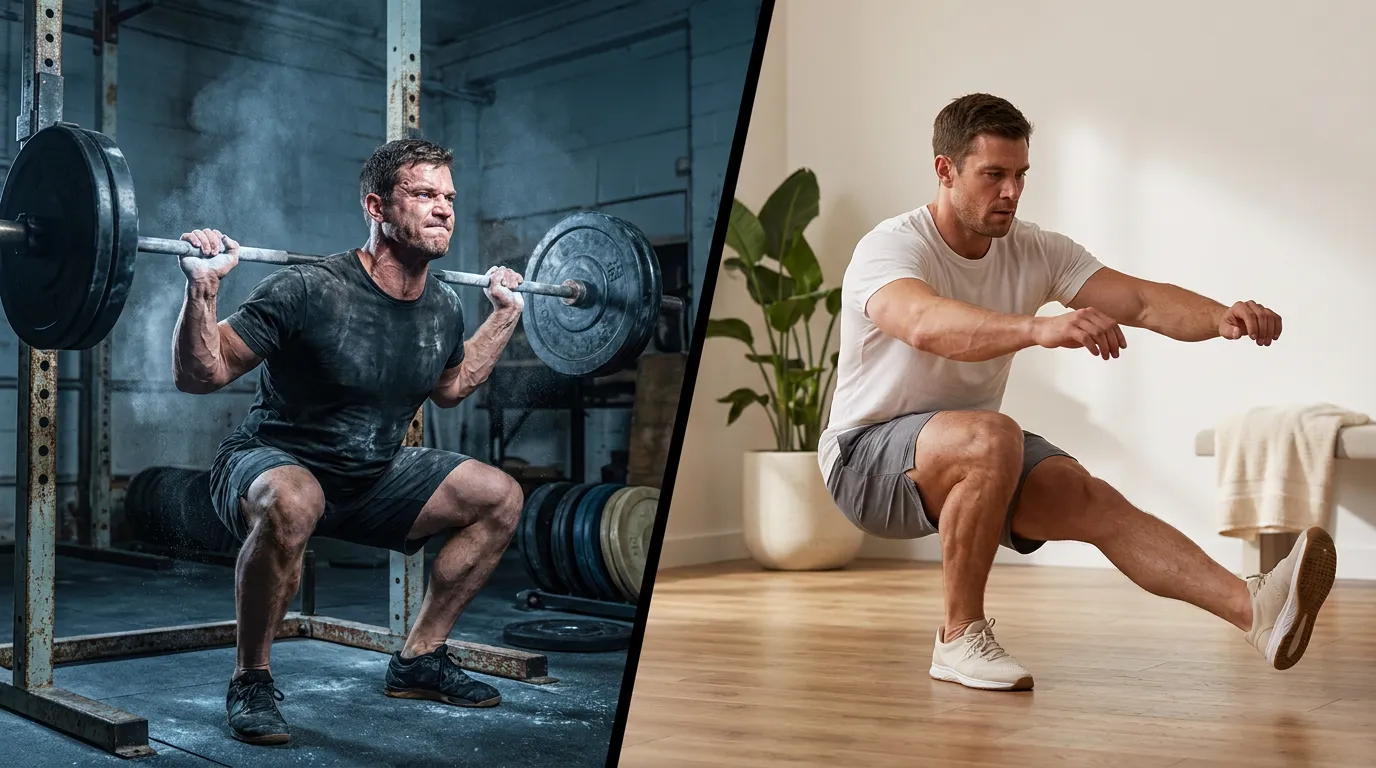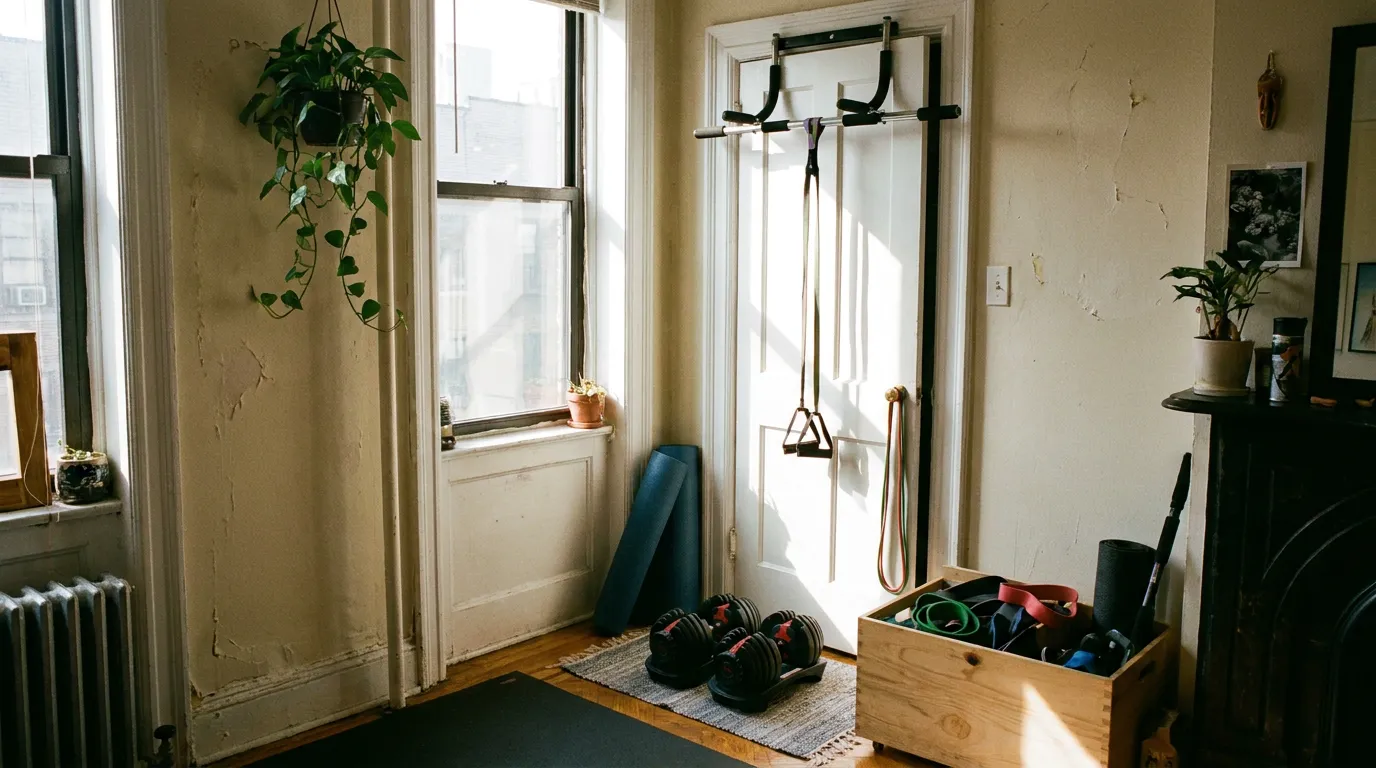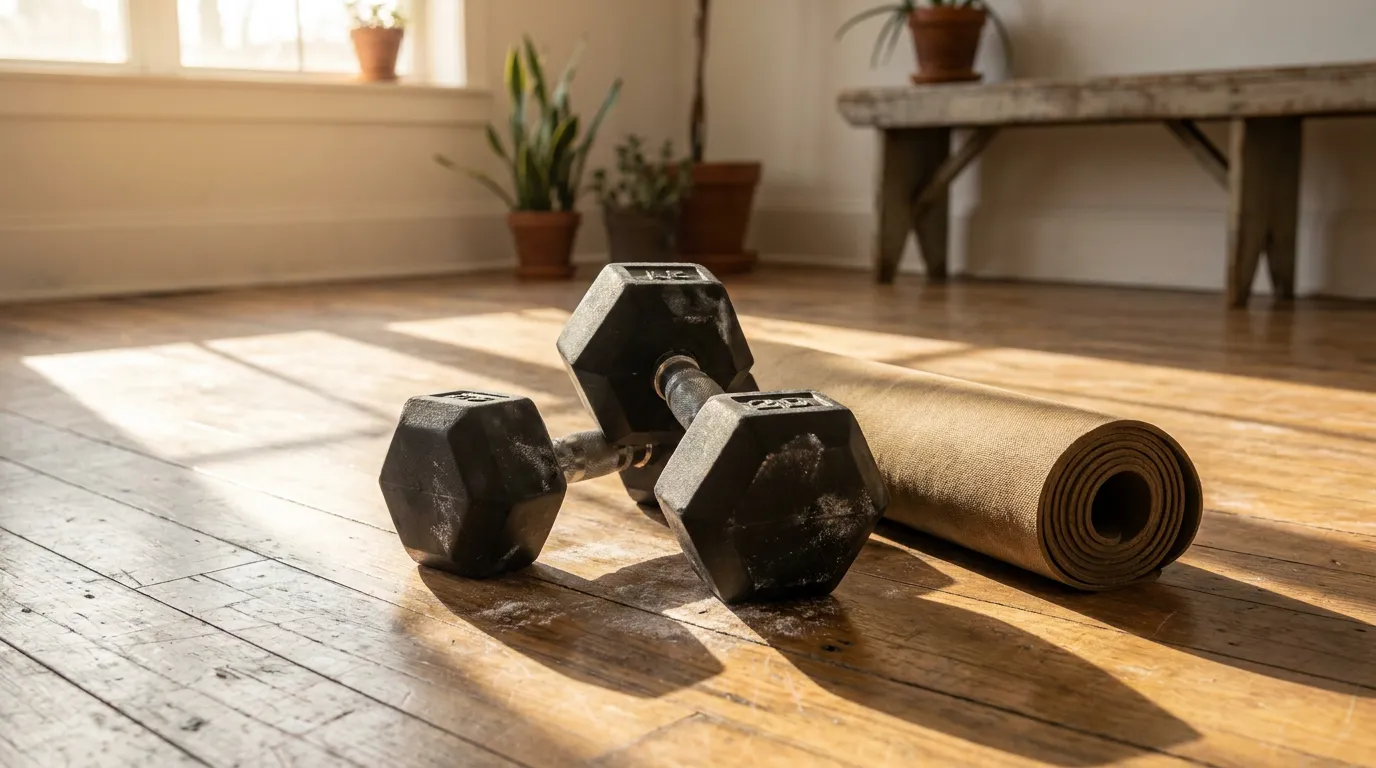
The modern fitness industry has a love affair with complexity: cable machines with twenty pulleys, smart mirrors that analyze your reflection, and subscriptions that gamify every calorie.
But step into a physical therapist’s clinic, a military conditioning facility, or a seasoned strength coach’s garage, and you will almost always find the same quiet workhorse sitting in the corner: a simple pair of dumbbells.
They do not require electricity. They do not break down. They do not care about your subscription status. They simply obey the laws of physics and respond to your physical effort.
If you are building a home training system, dumbbells are not just an option; they are a highly efficient bridge between basic bodyweight movements and heavy loading. However, viewing dumbbells merely as “beginner tools” or “isolation accessories” misses their biomechanical value entirely. Used correctly, they are among the most versatile, strength-building instruments you can own.
This guide outlines why dumbbells work, how to select the right pair for your budget, and how to keep making progress when you do not have a commercial rack of weights at home.
The Stabilizer Advantage: Why Two Are Better Than One
When you grip a standard barbell, both hands are locked onto a single, rigid steel shaft. If your right side is stronger than your left (as is common), it can unconsciously compensate. The bar still rises, the workout gets logged, but your lateral strength asymmetries are quietly reinforced.
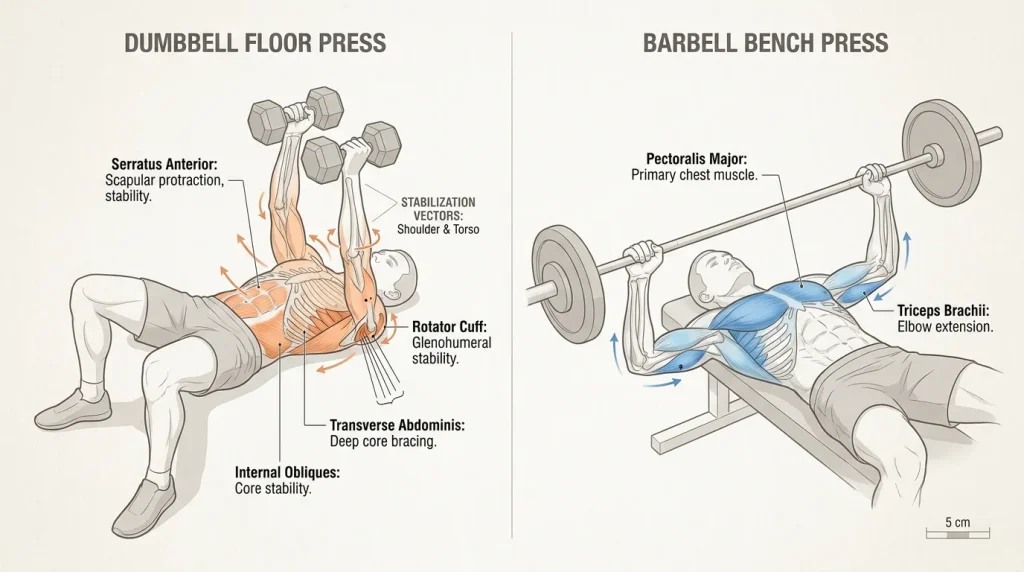
Dumbbells remove that safety net. Because each limb must operate independently, your nervous system is forced to recruit deep stabilizing muscles to control, balance, and direct the load in three-dimensional space.
A landmark study published in the European Journal of Applied Physiology by Saeterbakken and Fimland (2013) compared core and limb activation between bilateral and unilateral exercises [6]. The researchers demonstrated that unilateral training (loading one limb at a time) significantly increases the recruitment of stabilizing muscles—such as the obliques, transverse abdominis, and rotator cuff fibers—to resist trunk rotation and joint deviation.
“Independent limb loading exposes and corrects strength imbalances that bilateral training can mask. Over time, this builds joint resilience and movement quality that translates directly to daily life.” — Dr. Stuart McGill, Spine Biomechanics Expert [2]
By incorporating dumbbells into your home strength training, you are not just developing prime movers like your chest and quadriceps; you are reinforcing the secondary stabilizers that hold your joints together.
Beyond the Bicep Curl: Dumbbells as Compound Builders
The myth that dumbbells are only useful for isolated arm curls persists because of poorly structured programming. While isolation work has its place, dumbbells truly shine when integrated into compound movement patterns that demand full-body coordination.
Key Biomechanical Advantages of Dumbbells
- Natural Joint Paths: Unlike a fixed barbell, dumbbells allow your wrists, elbows, and shoulders to rotate naturally. This allows your joints to track along their anatomically optimal paths, significantly reducing shear stress on your shoulders and elbows [2].
- Grip and Forearm Demand: Controlling independent loads requires active hand and forearm engagement. Developing grip strength is not just for performance; clinical research consistently links grip strength to long-term functional independence and longevity [4].
- Range of Motion (ROM) Flexibility: Dumbbells allow you to go deeper on a goblet squat, achieve a deeper stretch at the bottom of a floor press, or alter your foot stance on a lunge without fighting a rigid frame.
Foundational Dumbbell Movements
To build a highly effective routine, program your workouts around these foundational compound patterns:
- Lower Body: Goblet squats, Romanian deadlifts, reverse lunges, step-ups.
- Upper Body Push: Dumbbell floor presses, single-arm overhead presses.
- Upper Body Pull: Single-arm rows, chest-supported rows (leaning on sturdy furniture).
- Core Integration: Farmer’s carries, suitcase carries, halos, dead bugs (holding light loads).
The Weight Dilemma: Fixed vs. Adjustable
You do not need a full commercial rack of weights lining your wall. You need a practical equipment strategy.
Fixed Dumbbells
- Pros: Exceptionally durable, psychologically satisfying, and extremely fast to transition between sets.
- Cons: Consume physical space quickly and require a high financial investment as you get stronger.
- The Smart Purchase: If you prefer fixed weights, purchase two pairs to start: one lighter pair (8 to 12 lbs) for upper-body movements and accessory work, and one moderate-to-heavy pair (20 to 25 lbs) for lower-body compound lifts.
Adjustable Dumbbells
- Pros: Highly space-efficient and exceptionally cost-effective. Modern dial-lock or pin-selector systems let you change your working weight in seconds.
- Cons: Slightly bulkier handles and require careful handling to protect the internal adjustment mechanisms.
- The Smart Purchase: If your budget or floor space is limited, a single pair of adjustable dumbbells is the ultimate minimalist solution.
“Simplicity scales. Complexity fractures. The best equipment is the kind that disappears into the background so you can focus on the movement.” — Dan John, Strength Coach and Author of Intervention [5]
The Progression Puzzle: Advancing Without a Full Rack
In a commercial gym, progressive overload is easy: when an exercise feels comfortable, you grab the next pair of dumbbells. At home, you might only own a single fixed pair or a modest adjustable set, and purchasing heavier iron is not always an immediate option.
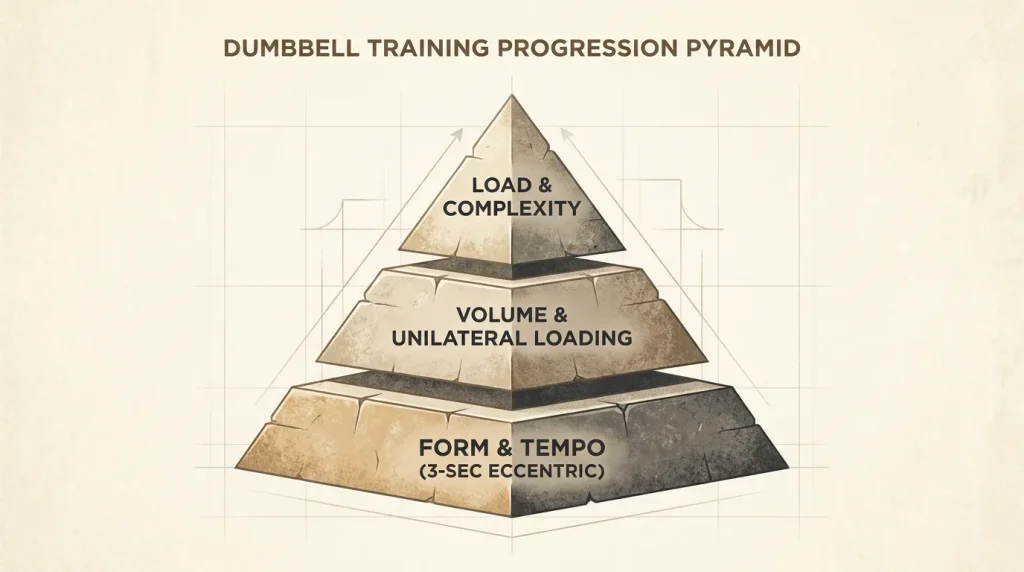
To keep progressing, you must manipulate alternative variables to increase muscle fiber recruitment [1]:
- Tempo Manipulation: Slow down the eccentric (lowering) phase of your lifts to 3 to 4 seconds. This increases the muscle’s time under tension and metabolic stress without requiring any added weight.
- Pause Repetitions: Pause for 2 full seconds at the bottom of a lunge, squat, or press. This removes the “stretch reflex” (elastic momentum), forcing your muscles to work harder from a dead stop.
- Unilateral Focus: Move from double-leg movements to single-leg variations. For example, performing a single-leg Romanian deadlift with a moderate dumbbell creates a much greater relative demand on your hamstrings and hip stabilizers than a double-leg deadlift with the same weight.
- Density Training: Maintain your working weight and reps, but reduce your rest periods between sets by 10 to 15 seconds.
The 20-Minute Dumbbell Foundation Routine
The dumbbell program detailed below is an independent, highly effective manual layout you can follow if you choose to train on your own.
App Integration Tip: If you are a FitSekai user, there is no need to manually coordinate exercises, track times, or write down rep schemes. We recommend launching Module #55: Dumbbell Experience, under the program Dumbbell Experience: Beginner Fullbody 1, specifically the workout Dumbbell Experience: Beginner Fullbody 1.
Launching this session in the app automates your active timers and transitions, allowing you to focus entirely on your movement mechanics.
Alternate Workout Structure: 3-Round Circuit
Perform each of the 5 movements below for 40 seconds, followed by 20 seconds of recovery. Rest for 60 seconds after completing all 5 movements, then repeat the circuit for a total of 3 rounds.
- Warm-Up (2 Minutes): Spend 2 minutes preparing your joints with slow arm circles, torso rotations, and dynamic bodyweight squats.
- Station 1: Goblet Squat (Squat Pattern): Hold one dumbbell vertically by the head at chest height, elbows tucked close to your ribs. Lower your hips back and down into a deep squat, keeping your torso tall. Press through your heels to stand.
- Station 2: Single-Arm Dumbbell Floor Press (Push Pattern): Lie flat on your back on your mat, knees bent and feet flat on the floor. Hold a single dumbbell in your right hand, arm extended straight up. Lower your elbow slowly until your upper arm touches the floor, pause, and press back up. Switch arms next round.
- Station 3: Dumbbell Romanian Deadlift (Hinge Pattern): Stand hip-width apart, holding a dumbbell in each hand in front of your thighs. Keeping a flat back and a very slight bend in your knees, push your hips backward as you lower the weights along your shins. Squeeze your glutes to stand.
- Station 4: Single-Arm Dumbbell Row (Pull Pattern): Place your left hand and left knee on your couch or a sturdy chair for support, keeping your back flat and parallel to the floor. Hold a dumbbell in your right hand, letting it hang straight down. Row the dumbbell toward your hip, keeping your elbow tucked. Switch sides halfway through the set.
- Station 5: Alternating Reverse Lunge with Suitcase Carry (Lunge Pattern): Stand tall, holding a dumbbell in each hand by your sides like suitcases. Step backward with your right foot, lowering your hips until your back knee hovers just above the floor. Push off your front heel to return to standing. Switch legs.
- Cooldown (1 Minute): Spend 1 minute performing standing hamstring stretches and slow, deep diaphragmatic breathing.
Smarter Dumbbell Training with FitSekai
If you are training with limited equipment, FitSekai’s digital training platform can help you progress safely:
- RPE Adaptive Engine: After every session, you rate your physical effort on our simple post-workout scale. FitSekai’s Smart Adaptive Training engine immediately adjusts your upcoming sessions—automatically scaling your reps, adding pauses, or slowing down tempos—to ensure you continue making progress without needing to buy heavier weights.
- The Custom Routine Maker: FitSekai features a flexible Routine Maker, allowing you to easily build a customized home program by mixing and matching our dumbbell-only strength, conditioning, and core routines from a library of over 1,800 sessions.
- Hands-Free Audio Cues: Because exercises like single-arm rows, floor presses, or renegade rows require you to look at the floor or the ceiling, looking at a phone screen is highly disruptive. FitSekai’s Text-to-Speech (TTS) engine resolves this by delivering clear audio workout cues as you transition between exercises, along with manually activated audio descriptions of form cues when you need a quick technical reminder.
- Ad-Free, Offline, and Private: FitSekai is completely ad-free, runs smoothly in True Offline Mode, and operates under an Absolute Privacy policy—all your personal weight logs and fitness metrics stay safely on your local device.
Access the complete Dumbbell Experience module and start training smarter with FitSekai premium:
- Monthly Subscription: $2.99
- Annual Subscription: $24.99 (Best Value)
- Each subscription includes a completely risk-free trial.
Final Thought: Gravity Does Not Care About Your Setup
Your muscles do not care about the brand of your weights, the color of your mat, or the complexity of your equipment. They respond to physical tension, mechanical overload, and consistency [1].
Dumbbells do not forgive sloppy mechanics, but they reward dedicated effort. They force you to own every inch of the movement, expose structural imbalances before they turn into chronic injuries, and scale smoothly from basic rehabilitation to elite conditioning.
You do not need a commercial warehouse. You need a pair of weights, a patch of floor, and the discipline to move them with intent.
📎 Read Next:
- The Complete Guide to Effective Home Workouts
- How to Create a Home Gym for Under $100
- Bodyweight Training: Is It Enough to Build Real Strength?
- Strength Training 101: A Complete Beginner’s Guide
References & Further Reading
- Schoenfeld, B. J. (2023). Science and Development of Muscle Hypertrophy (2nd ed.). Human Kinetics. (The physiology of mechanical tension and hypertrophic progression) [1].
- McGill, S. M. (2024). Low Back Disorders: Evidence-Based Prevention and Rehabilitation (3rd ed.). Human Kinetics. (Principles of unilateral loading, spine mechanics, and joint stabilization) [2].
- American College of Sports Medicine. (2024). ACSM’s Guidelines for Exercise Testing and Prescription (11th ed.). Wolters Kluwer. (Standard musculoskeletal conditioning guidelines and prescriptions) [3].
- National Strength and Conditioning Association. (2024). Essentials of Strength Training and Conditioning (5th ed.). Human Kinetics. (Foundational program design metrics, load progression rules, and Golgi tendon organ mechanisms) [4].
- John, D. (2021). Intervention: A Four-Part Plan to Fix America’s Health Crisis. Post Hill Press. (The benefits of minimalist, highly functional training equipment) [5].
- Saeterbakken, A. H., & Fimland, M. S. (2013). Muscle activity of the core during resistance exercises. European Journal of Applied Physiology, 113(5), 1179-1190. (Peer-reviewed analysis proving stabilizer recruitment during unilateral loading) [6].
ID: 26010
Category: Home Workouts
Content Type: Equipment Deep Dive
Intent: Commercial Investigation / Informational
Word Count: ~1,580 words
Reading Time: ~7 minutes
IMPORTANT LEGAL & CREATIVE DISCLAIMERS
Artificial Intelligence & Generation Disclosure
Please be advised that the written text, formatting structures, hierarchical organization, and creative image generation prompts contained in this guide were researched, structured, and produced with the assistance of advanced artificial intelligence technologies. While the raw narrative generation was AI-aided, all historical references, anatomical mechanisms, and scientific studies (such as the peer-reviewed clinical data from the European Journal of Applied Physiology and Sports Medicine) have been manually reviewed, cross-referenced, and verified for complete factual accuracy. All visual representations, graphic plans, and layout options are conceptual and have been generated with the assistance of artificial intelligence tools.
Health & Physical Activity Advisory
The information and educational materials provided in this guide are intended solely for general informational and learning purposes and do not constitute professional medical advice, clinical physiological diagnosis, or direct medical treatment. Engaging in any physical exercise program, particularly when utilizing modified home furniture or budget equipment, carries inherent risks of physical injury. It is strongly recommended that you consult with a qualified physician or certified healthcare professional before beginning any new training program, especially if you have pre-existing cardiovascular, metabolic, or musculoskeletal conditions. Stop exercising immediately if you experience pain, dizziness, or chest tightness.