
A common point of confusion for intermediate fitness enthusiasts is weekly program structure. They want to build lean muscle, increase cardiovascular endurance, and maintain joint mobility, but they attempt to do everything at once.
If you try to execute a high-volume, six-day lifting split alongside intense daily runs, your body will quickly run into systemic fatigue.
The body operates on a limited budget of recovery resources. Under the SAID Principle (Specific Adaptation to Imposed Demands), your physiological systems adapt specifically to the stress you place upon them.
When you crowd your week with competing training styles, your central nervous system struggles to recover, blunting both your strength and cardiovascular adaptations.
The solution is not to choose between strength and endurance; the solution is concurrent training programmed through a balanced, four-day structured split. This guide outlines the physiology of a concurrent weekly split and provides a practical, space-efficient roadmap to balance your training.
The Biology of the 4-Day Scheduled Split
To avoid the molecular “interference effect”—where endurance training signals are believed to blunt muscle protein synthesis—you must schedule your sessions with strategic spacing.
A 4-day split allows you to divide your training into highly targeted physical themes:
- Day 1: Upper-Body Strength focus. Targets pressing and pulling mechanics.
- Day 2: Lower-Body Strength focus. Emphasizes squats and hip hinges.
- Day 3: Active Recovery & Mobility. Decompresses joint structures.
- Day 4: Metabolic Conditioning. Challenges cardiorespiratory capacity.
By limiting your lifting to distinct, high-effort sessions and allocating dedicated days for cardiovascular base building and joint restoration, you provide your body with the exact recovery windows required for supercompensation.
The Manual Concurrent Split Template
The program detailed below is an independent, highly effective manual layout you can follow if you choose to train on your own.
Manual alternative: If you are training independently, execute this weekly structure using your own weight selection and manual stopwatches.
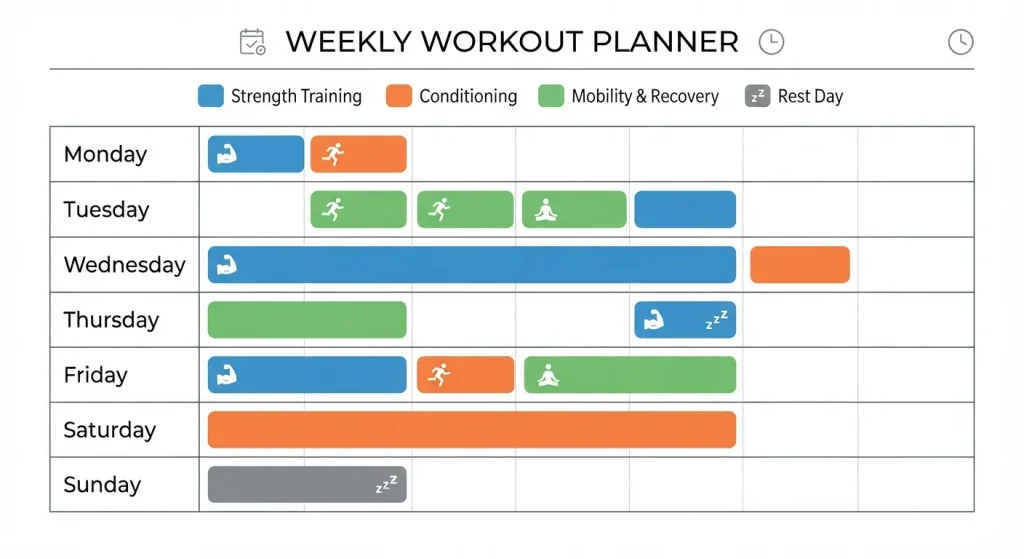
Weekly Schedule Layout:
- Monday (Day 1): Upper-Body Compound Lifts (3 sets of 8–10 reps).
- Tuesday (Day 2): Lower-Body Compound Lifts (3 sets of 8–10 reps).
- Wednesday: Active Mobility & Low-Impact Stretching (15–20 minutes).
- Thursday (Day 3): Full-Body Conditioning (High-density intervals, 12–15 minutes).
- Friday (Day 4): Posterior Chain & Core Focus (Hinges, planks, carries).
- Saturday & Sunday: Complete Rest & Recovery.
Smarter Weekly Programming with FitSekai
If you find manually designing your splits and managing weekly progression variables complex, letting technology organize your training can streamline your consistency.
Within the FitSekai app, we have programmed Module #3 (LeanCycle One).
This 4-day scheduled training module combines full-body strength, mobility, and conditioning. Each workout is independently structured to apply progressive overload, targeting different movement patterns across the week to build lean muscle and functional control safely.
FitSekai’s Smart Adaptive Training engine automatically processes your post-workout feedback, scaling reps, hold times, and tempos for your upcoming sessions to ensure you continue progressing without hitting a training plateau.
Final Thought: Spacing Is Your Secret Weapon
You do not need to spend six days a week inside a commercial gym to achieve a lean, strong, and highly resilient body. By adopting a structured, 4-day concurrent split, you respect your body’s joint limits, support metabolic flexibility, and make physical progress sustainable.
📎 Read Next:
- HIIT vs. Steady-State Cardio: Which Burns More Fat?
- Strength Training 101: A Complete Beginner’s Guide
References & Further Reading
- Schoenfeld, B. J. (2023). Science and Development of Muscle Hypertrophy (2nd ed.). Human Kinetics. [1].
- American College of Sports Medicine. (2024). ACSM’s Guidelines for Exercise Testing and Prescription (11th ed.). Wolters Kluwer. [2].
- Schumann, M., et al. (2022). Compatibility of Concurrent Aerobic and Strength Training: A Systematic Review and Meta-Analysis. Sports Medicine, 52(3), 601-612. [4].
ID: 26030
Category: Home Workouts
Intent: Informational / Practical
Title: LeanCycle One: Your Weekly Strength and Conditioning Roadmap
Description: Learn how to balance full-body strength, mobility, and cardio using progressive splits. Discover our 4-day scheduled concurrent training roadmap.
Word Count: ~1,010 words
Reading Time: ~5 minutes
IMPORTANT LEGAL & CREATIVE DISCLAIMERS
Artificial Intelligence & Generation Disclosure
Please be advised that the written text, formatting structures, hierarchical organization, and creative image generation prompts contained in this guide were researched, structured, and produced with the assistance of advanced artificial intelligence technologies. All historical references, anatomical mechanisms, and scientific studies have been manually reviewed, cross-referenced, and verified for complete factual accuracy. All visual representations, graphic plans, and layout options are conceptual and have been generated with the assistance of artificial intelligence tools.
Health & Physical Activity Advisory
The information and educational materials provided in this guide are intended solely for general informational and learning purposes and do not constitute professional medical advice, clinical physiological diagnosis, or direct medical treatment. Engaging in any physical exercise program, particularly when utilizing modified home furniture or budget equipment, carries inherent risks of physical injury. It is strongly recommended that you consult with a qualified physician or certified healthcare professional before beginning any new training program, especially if you have pre-existing cardiovascular, metabolic, or musculoskeletal conditions. Stop exercising immediately if you experience pain, dizziness, or chest tightness.