You show up. You sweat. You go home. You do it again three days later.
And yet, months go by, and the mirror looks identical. The scale has not moved. Your lifts are stuck at the exact same repetitions.
It is highly frustrating. You are putting in the physical effort. So why are you not getting the results?
The answer lies in a biological law that is frequently misunderstood: your body is metabolic. It wants to survive while burning the absolute fewest calories possible.
Muscle tissue is incredibly “expensive” for your body to maintain. It requires significant energy and protein synthesis to support. If you do not give your body an escalating, urgent biological reason to grow, it will always default to maintaining the status quo.
This is the core concept of progressive overload. It is the single most important foundational principle in exercise science. Without it, you are merely “exercising”—burning calories in the moment, but triggering zero long-term structural changes.
This guide breaks down the biological mechanics of progressive overload, explains why adding weight is not the only way to challenge your muscles, and shows you how to apply these methods intelligently so you break plateaus without breaking your joints.
The Biological Imperative: The SAID Principle
In exercise physiology, there is a foundational acronym: SAID. It stands for Specific Adaptation to Imposed Demands [4].
Put simply: your body adapts specifically to the exact physical stress you place upon it.
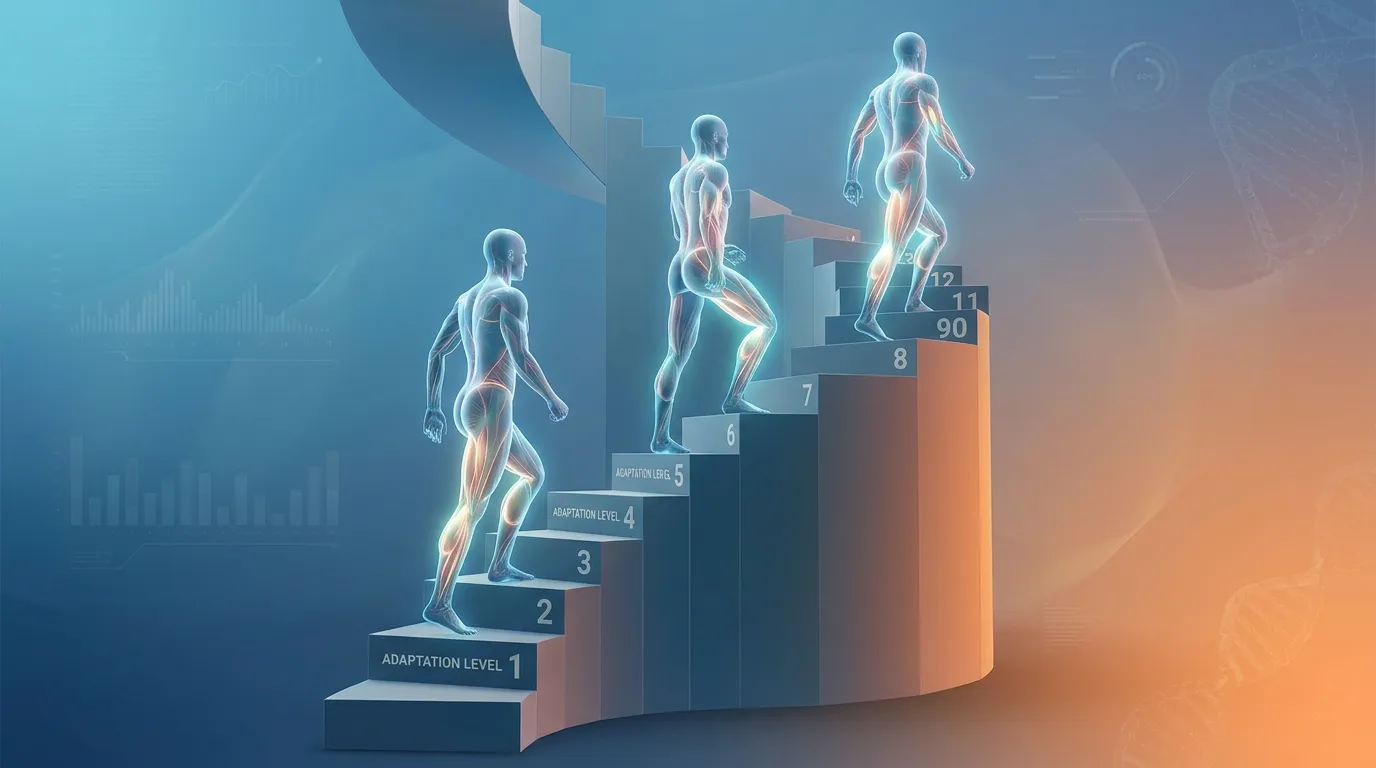
If you ask your body to lift a 20-pound dumbbell today, and you ask it to lift that same 20-pound dumbbell next month, you have not imposed a new demand. Consequently, your body has no biological reason to adapt. It has already solved the mechanical problem of “lifting 20 pounds.”
To force adaptation, you must continually escalate the demand. You must prove to your central nervous system and muscle fibers that your current state of strength is no longer sufficient for survival.
“Adaptation is not a reward for working out. It is a survival response to a stressor that threatens homeostasis. If the stress doesn’t increase, the adaptation stops.” — Brad Schoenfeld, PhD, Leading Hypertrophy Researcher [1]
When a muscle fiber is exposed to a novel mechanical stressor, it triggers an intracellular signaling cascade (specifically activating the mTOR pathway), which stimulates muscle protein synthesis. If the stressor remains the same, the signal diminishes, and muscle growth plateaus.
Beyond “Add Weight”: The 4 Levers of Progression
Here is where most beginners get stuck. They hear “progressive overload explained” and immediately think: I must add 5 pounds to the bar every single week.
In reality, that is a direct path to joint strain or injury. No human can progress in a perfectly linear fashion forever. Eventually, you run out of physical weight, or your joint structures give out.
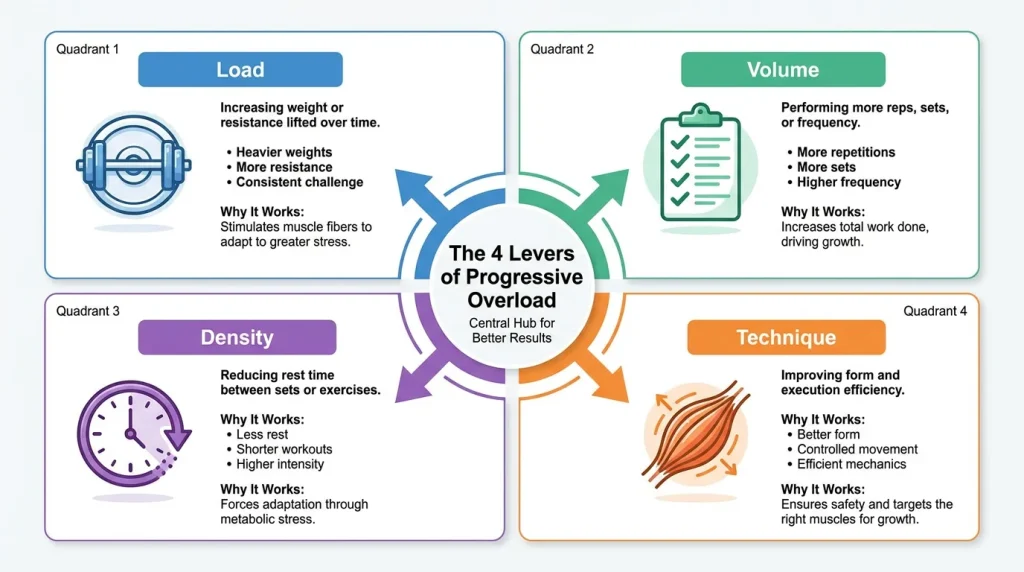
True progressive overload is achieved by manipulating four different mechanical variables. Think of these as the “Levers” you can pull to increase muscle recruitment without necessarily making the weight heavier:
Lever 1: Load (The Absolute Force)
This involves adding weight to the dumbbell, barbell, or resistance band.
- When to use: When your movement quality is perfect, and you can easily hit the top of your targeted repetition range.
- The Risk: Adding load too quickly leads to “ego lifting,” poor form, and harmful joint shear.
Lever 2: Volume (The Total Work)
This involves increasing the total amount of physical work completed during a session (Sets × Repetitions × Weight).
- When to use: When you want to stimulate muscle growth (hypertrophy) but your joints are not ready for a heavier absolute load.
- The Science: Volume is a primary driver of muscle growth. Performing more total repetitions increases the cumulative time your muscle fibers spend under active mechanical tension [1].
Lever 3: Density (The Rest Interval)
This involves performing the exact same amount of physical work in less time by reducing your rest periods.
- When to use: When you want to increase metabolic stress, local muscular endurance, and cardiovascular conditioning.
- Example: If you completed 3 sets of 10 squats resting 60 seconds between sets last week, resting only 45 seconds between those sets this week increases the metabolic demand on your quadriceps.
Lever 4: Technique & Tempo (The Time Under Tension)
This involves improving your movement control and slowing down your repetitions to eliminate momentum.
- When to use: When you have limited equipment or want to build maximum joint stability.
- Example: Instead of dropping quickly into a squat and bouncing up, spend 4 full seconds lowering down (eccentric focus) and pause for 2 seconds at the bottom before rising [5]. This increases Time Under Tension (TUT) and forces your muscle fibers to work through a dead-stop.
The “Goldilocks” Zone: Fatigue vs. Supercompensation
To apply progressive overload effectively, you must understand The Supercompensation Curve.
When you train, you do not actually get stronger in the gym; you induce micro-damage and accumulate fatigue. Your physical capacity temporarily drops. During the recovery phase, your body repairs the tissue, bringing you back to your baseline strength—and then slightly above it (supercompensation).
The 4 Phases of the Supercompensation Curve
- 💥 Phase 1: Stimulus & Fatigue (The Workout): As you train, your physical performance capacity temporarily drops due to micro-tears in muscle fibers and the depletion of local energy stores (glycogen).
- 🛌 Phase 2: Recovery (The Restoration): During rest, sleep, and proper nutrition, your body repairs structural damage, clears metabolic waste, and gradually restores your physical capacity back to your initial baseline.
- ⚡ Phase 3: Supercompensation (The Adaptation Peak): Your body anticipates future demands by temporarily building your capacity above your original baseline, creating a peak window of heightened strength and readiness.
- 📉 Phase 4: Detraining (The Return to Baseline): If you do not apply a new physical stimulus during the supercompensation peak, your body naturally sheds the “expensive” adaptation, gradually returning to your starting baseline.
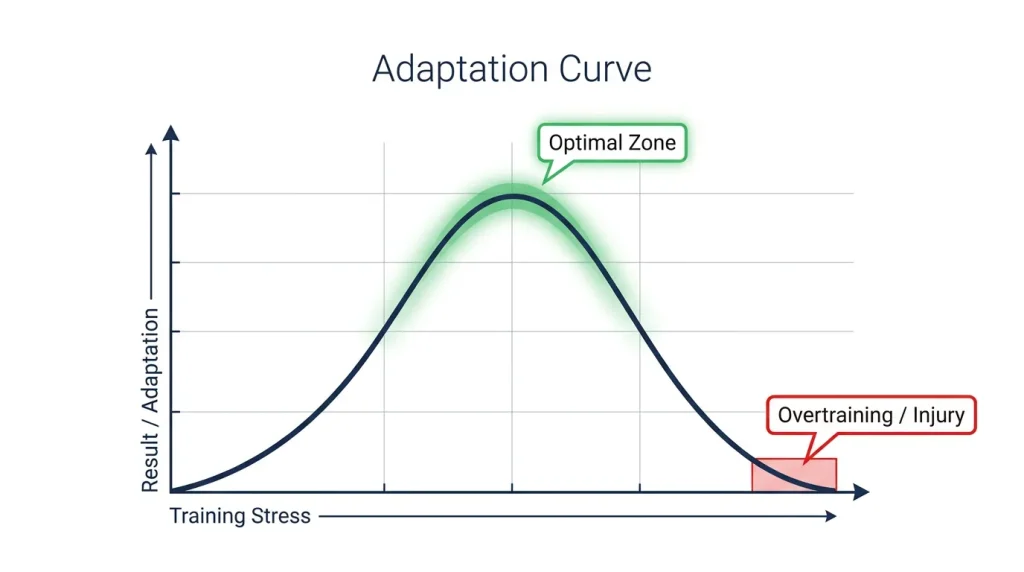
The challenge is finding the “Goldilocks” zone:
- If you overload too little: You stay at baseline. Your body has no reason to adapt, and you experience a plateau.
- If you overload too much: Fatigue accumulates faster than your body can recover. Your performance drops, your joints ache, your sleep quality declines, and you risk overtraining.
Auto-Regulation: Why Static Plans Fail
This is why generic, static training calendars often fail. A static PDF workout template might command: “Week 4: Add 10 pounds to your squat.”
But what if you only slept four hours last night? What if you are highly stressed at work? What if your nutrition was poor? Forcing your body to add 10 pounds under high fatigue is a direct recipe for joint injury.
Conversely, what if you feel energetic and strong? Sticking to a rigid, conservative weight limit prevents you from capitalizing on your body’s readiness.
You are not a robot with a fixed daily recovery rate. You are an adaptive biological system.
“The best progression plan is one that listens to the body. Rigid periodization assumes linear recovery. Adaptive programming assumes human variability.” — Dr. Mike Israetel, Sport Physiologist [5]
To solve this, sports scientists utilize Auto-Regulation—adjusting your workout intensity dynamically based on real-time physiological feedback [5].
How FitSekai Automates Your Progression
The FitSekai app utilizes an advanced Smart Adaptive Training engine to remove the guesswork of progressive overload.
Instead of following an unyielding calendar, the app prompts you to rate your physical effort on a simple scale after every session (your Rate of Perceived Exertion, or RPE) [5].
- If you rate a session “Too Easy”: FitSekai’s engine immediately adjusts your upcoming workouts, pulling the Load or Volume levers to keep you progressing.
- If you rate a session “Too Hard”: The system recognizes accumulated fatigue. Instead of forcing you to lift more, it automatically scales back reps, increases rest times, or schedules a recovery session to keep your joints safe.
This feedback-loop ensures you are always training within your optimal adaptive zone, preserving your joint health while systematically breaking fitness plateaus.
Your Action Plan: The “Double Progression” Method
If you are training on your own without an adaptive app, the safest, most reliable manual progression method is Double Progression. This method ensures you only increase weight once your muscles have thoroughly mastered the current workload.
Step-by-Step Execution of Double Progression:
- Select a Repetition Range: For example, 8 to 12 repetitions.
- Find Your Starting Weight: Choose a load where you can complete 8 clean repetitions, leaving 1 to 2 reps in reserve.
- Maintain the Weight: Keep the weight identical in subsequent workouts, but strive to add repetitions. (e.g., Week 1: 3 sets of 8, Week 2: 3 sets of 10, Week 3: 3 sets of 11).
- Hit the Ceiling: Continue until you can comfortably complete the top of the range (12 repetitions) for all target sets with clean technique.
- Increase the Load: Increase the weight by the smallest increment possible (usually 2.5 to 5 lbs).
- Reset: Drop back down to the bottom of the range (8 repetitions) with the new weight, and repeat the cycle.
This manual feedback loop prevents ego lifting and guarantees steady, biological strength gains.
Final Thought: A Dialogue, Not a Command
Progressive overload is not about suffering, lifting until you collapse, or ignoring pain.
It is a structured physical dialogue with your body. You ask your neuromuscular system to do slightly more than it did last time. It adapts by building denser muscle and stronger bones. Then, you ask again.
If you listen to the biological feedback, this physical dialogue can support your health and functional strength for a lifetime [2].
📎 Read Next:
- Strength Training 101: A Complete Beginner’s Guide
- The First 5 Exercises Every Beginner Should Master
- How Much Weight Should You Lift? (Finding Your Starting Point)
- Strength Training for Women: Debunking the Bulky Myth
References & Further Reading
- Schoenfeld, B. J. (2023). Science and Development of Muscle Hypertrophy (2nd ed.). Human Kinetics. (Evidence-based resource on mechanical tension, muscle protein synthesis, and overload) [1].
- American College of Sports Medicine. (2024). ACSM’s Guidelines for Exercise Testing and Prescription (11th ed.). Wolters Kluwer. (Authoritative clinical guidelines for cardiorespiratory and musculoskeletal health prescription) [2].
- National Strength and Conditioning Association. (2024). Essentials of Strength Training and Conditioning (5th ed.). Human Kinetics. (Neuromuscular adaptations, load management, and strength progression) [3].
- Garber, C. E., Blissmer, B., Deschenes, M. R., et al. (2011). Quantity and Quality of Exercise for Developing and Maintaining Cardiorespiratory, Musculoskeletal, and Neuromotor Fitness in Apparently Healthy Adults. Medicine & Science in Sports & Exercise, 43(7), 1334-1359. (ACSM Position Stand on progressive overload and exercise prescription rules) [4].
- Helms, E. R., Cronin, J., Storey, A., & Zourdos, M. C. (2016). Application of the Repetitions in Reserve-Based Rating of Perceived Exertion Scale for Resistance Training. Journal of Strength and Conditioning Research, 30(1), 267-273. (The seminal study on auto-regulation, RPE, and subjective feedback systems) [5].
ID: 26012
Category: Strength Training
Content Type: Science Deep Dive / Practical Guide
Intent: Informational
Word Count: ~1,610 words
Reading Time: ~7 minutes
IMPORTANT LEGAL & CREATIVE DISCLAIMERS
Artificial Intelligence & Generation Disclosure
Please be advised that the written text, formatting structures, hierarchical organization, and creative image generation prompts contained in this guide were researched, structured, and produced with the assistance of advanced artificial intelligence technologies. While the raw narrative generation was AI-aided, all historical references, anatomical mechanisms, and scientific studies (such as the peer-reviewed clinical data from the National Strength and Conditioning Association and Human Kinetics) have been manually reviewed, cross-referenced, and verified for complete factual accuracy. The visual illustrations indicated by placeholders represent creative concepts designed to be rendered using AI-assisted graphic and photographic engines.
Health & Physical Activity Advisory
The information and educational materials provided in this guide are intended solely for general informational and learning purposes and do not constitute professional medical advice, clinical physiological diagnosis, or direct medical treatment. Engaging in any physical exercise program, particularly when utilizing modified home furniture or budget equipment, carries inherent risks of physical injury. It is strongly recommended that you consult with a qualified physician or certified healthcare professional before beginning any new training program, especially if you have pre-existing cardiovascular, metabolic, or musculoskeletal conditions. Stop exercising immediately if you experience pain, dizziness, or chest tightness.